





Church history is about more than learning names and dates. It is about seeing how God has worked through ordinary people to build his church. The best history books do more than tell us what happened. They help us learn from faithful Christians whose lives still encourage us today. Tiyo Soga and His Mentors, edited by Ferdie Mulder and Ivette Coetsee, is one of those books. It introduces readers to one of South Africa’s most important Christian leaders. More importantly, it reminds us that Tiyo Soga should first be remembered as a faithful servant of Jesus Christ.
Tiyo Soga should first be remembered as a faithful servant of Jesus Christ.
Many South Africans know something about Tiyo Soga. He was the first black South African to be ordained as a Presbyterian minister. He translated Christian books into isiXhosa, worked on the translation of the Bible, wrote hymns, worked as a journalist, and made an important contribution to South African history. These achievements are remarkable. However, the editors argue that they should never become the main reason we remember him. Before anything else, Soga was a preacher of the Gospel. His love for Christ and his commitment to Scripture shaped everything he did.
Knowing the Man and His Message
The book is carefully organised to support this argument. It is divided into two main parts. The first part follows Soga’s life and ministry, introducing the reader to his family, his calling, and the world in which he served. The second part turns to his writings and theology, allowing readers to engage with his own words and understand the convictions that shaped his ministry. At the centre of this second section is Soga’s famous 1866 YMCA address, which receives careful attention and helps readers see the theological heart of his work.
This structure works well because it allows readers to know both the man and his message. We first see the circumstances in which Soga lived, and then we are invited to consider what he actually believed and taught. The result is more than a biography. It is an introduction to a Christian minister whose theology shaped his life.
At the centre of Tiyo Soga’s life stood Christ.
We see something of this already in the account of Soga’s theological training (p37-40). His studies in Scotland weren’t easy. He had to work harder than many of the other students, yet he still found time to teach Sunday School in poorer parts of Glasgow. His professors described him as a devoted and serious student. At the end of his studies, they spoke of him as an “ambassador of Christ” returning to his own country. Their desire was that he would go back with love for Christ and a deep concern for the salvation of his countrymen. Soga’s own response was full of gratitude to God and affection for his brothers in Christ. Soon afterwards, in December 1856, he was ordained as a minister of the gospel.
This is important because it helps us understand Soga. His education mattered; so too his cultural identity. His place in South African history mattered. But at the centre of his life stood Christ and the gospel.
Letting Soga Speak for Himself
This Christ-centred picture of Soga is supported by one of the book’s greatest strengths: it doesn’t try to use him to support a modern political or cultural agenda. Instead, the editors want readers to understand him as he understood himself. Therefore they make extensive use of his letters, writings, hymns, and speeches, allowing Soga’s own voice to guide the discussion.
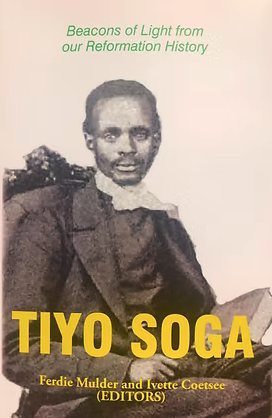
Tiyo Soga and His Mentors
Ferdie Mulder and Ivette Coetsee
Tiyo Soga and His Mentors
Ferdie Mulder and Ivette Coetsee
The accolades of Tiyo Soga—as a Xhosa minister, missionary, Bible translator, journalist, hymn writer, husband, and father—run a mile long. He was the first black South African to study and be ordained overseas; he was the first Xhosa Calvinist at the Cape to work as a missionary among his own people and Europeans; and he was the first African to translate John Bunyan’s classic allegory, The Pilgrim’s Progress, into an African language.
The book doesn’t try to use Soga to support a political or cultural agenda.
That approach is especially valuable because history is often interpreted through the concerns of the present. Every generation asks different questions of the past; and sometimes we end up making historical figures say more about our own time than about theirs. The editors recognise this danger, encouraging readers to begin with the original sources and to listen carefully before reaching conclusions. Whether one agrees with every argument or not, this careful approach deserves appreciation.
The opening chapters make the book’s main message clear. Soga’s greatest contribution wasn’t simply that he became an influential African leader. His greatest contribution was that he faithfully proclaimed Christ. His preaching, writing, translation work, and public ministry all flowed from his confidence in God’s word and his desire to see people come to faith in Jesus Christ.
I particularly appreciated this emphasis. Today, historical figures are often admired because of their influence, education or public achievements. This book reminds us to ask a different question: was this person faithful to Christ? That question shapes the whole volume and gives it a distinctly pastoral tone.
The Gospel in Soga’s Home
Soga’s commitment to Christ wasn’t limited to his public ministry. One of the most moving examples comes when we are given a letter Soga wrote to his sons in March 1871 (p95-97). At the time, Soga was helping with the translation of the Bible into isiXhosa. Yet what stands out is his concern for the souls of his children. He tells his boys to begin thinking about God while they are young and to love the Lord Jesus Christ. He reminds them that they have souls that need the love of God and the salvation found in Christ, just as their bodies need food.
Soga’s Christianity wasn’t only for the pulpit.
The letter also shows Soga as a father. He encourages his sons to work hard; have a good name; show gratitude to people who have been kind to them; and remember their family. Yet even these ordinary concerns are infused by his Christian convictions. He speaks of faithful Christians approaching death with confidence in Christ, and he ends by praying that God would bless his sons, keep them, and save their souls.
I found this deeply encouraging. Here we see that Soga’s Christianity wasn’t only for the pulpit. The missionary who wanted his fellow Xhosa people to know Christ also wanted his own children to know Christ. That should make Christian parents and pastors pause to think. Are we as concerned about Christ in our homes as we are about Christ in our churches?
Faithful to Christ Above Culture
The same commitment appears when we look at Soga’s relationship with the surrounding cultures. Another strength of the book is that it presents Soga as a real person rather than a simple hero. He loved his Xhosa people. Yet he was willing to challenge cultural practices that he believed were contrary to scripture. He valued much of what he received from Scottish Christianity while also recognising the failures and sins of European society. His loyalty was not finally to a culture or a political movement. His first loyalty was to Jesus Christ.
Soga’s first loyalty was to Jesus Christ.
That lesson is still relevant today. We often want to place people into reductionistic categories. But faithful Christians aren’t always easy to classify. This book encourages us to read history with humility, allowing the evidence to shape our understanding rather than forcing our own ideas onto the past.
This becomes especially clear where the book examines Soga’s response to the growing influence of theological liberalism (p153-156). In his 1866 address, Soga warned about a “new exegetical theology” that would alter the gospel and move away from the Reformation principles of interpreting scripture. His concern was deeply missional. What would happen if missionaries first told African people that the Bible was God’s word and then later returned to tell them that much of what they had taught was wrong? Soga understood that undermining confidence in scripture would also undermine the gospel being preached.
What I found particularly striking is that Soga was engaging these questions as early as the 1860s. Theological liberalism was gaining influence among European theologians and churches, only Soga refused to follow it. He stood firmly for the authority of scripture and what he called the “theology of the Reformation”. He wasn’t prepared to abandon biblical orthodoxy simply because newer ideas were becoming popular among educated people.
He experienced rejection from different sides but continued to hold to his Christian convictions.
And these were not simply academic words. Soga’s convictions were personally costly. He had turned down a financially attractive position with the colonial government because he believed it would compromise his calling; and he also refused Xhosa initiation practices that contained elements he believed were incompatible with biblical Christianity. He experienced rejection from different sides but continued to hold to his Christian convictions.
This is perhaps one of the most challenging parts of the book. Soga didn’t seem interested in asking which side would accept him. His deeper question was: what is faithful to Christ and his word? That is a question the Church still needs to ask today.
Recovering Our African Christian Heritage
Soga’s faithfulness also reminds us that Africa has a rich Christian heritage. Many of us have learned much from Martin Luther, John Calvin, Charles Spurgeon, and Martyn Lloyd-Jones. We should continue to read them. But we should also learn from faithful believers whom God raised up here in Africa. Tiyo Soga is one of those men. His story reminds us that Christ has always been building his Church among every nation and every people.
We don’t need to make Soga greater than he was. Neither do we need to turn him into an African version of a European theologian. We can simply receive him as he was: an African Christian, a Xhosa man, a husband and father, a translator, a missionary, and above all, a minister of Jesus Christ.
Pastors will especially benefit from reading this book.
Pastors will especially benefit from reading this book. Ministry is rarely easy. Faithful pastors often experience criticism, disappointment, rejection, and hardship. Soga also knew these struggles. Yet he continued preaching, teaching, translating, writing, and serving God’s people. His life reminds us that God calls his servants to faithfulness, not simply to visible success.
Theologically, the book is clearly evangelical and Reformed. Scripture remains at the centre, and the contributors take Soga’s own theological convictions seriously. They also explain the principles that guide their historical work, acknowledging that every historian has assumptions while seeking to treat the evidence honestly and fairly. That openness gives confidence to the reader.
Faithfulness; Not Fame
Perhaps the greatest contribution of Tiyo Soga and His Mentors is that it helps us think again about what true faithfulness looks like. We live in a world that celebrates popularity, influence, platforms, and public success. Even churches can begin measuring ministry in the same way. Soga’s life points us in a different direction. He reminds us that what matters most is not how widely we are known but whether we remain faithful to Christ.
This book helps us think again about what true faithfulness looks like.
This book is therefore more than a biography. It is an invitation to recover a forgotten gospel pioneer and, through his example, to remember the God who sustained him. Readers interested in South African church history, missions, Reformed theology, or faithful pastoral ministry will find much to appreciate.
More importantly, I believe they will finish the book with a deeper gratitude for God’s work on our continent. The same Christ who built his Church in Europe was building his Church here. The same Gospel that transformed lives elsewhere was at work among the Xhosa people. And the same Lord who sustained Tiyo Soga continues to build his Church today.
Perhaps recovering Tiyo Soga, then, is ultimately about something greater than recovering the memory of a single man. It is about recovering part of the story of Christ’s faithfulness to his Church in Africa. And perhaps Soga’s life can encourage us to serve that same Christ with humility, courage, conviction, and perseverance in our own generation.