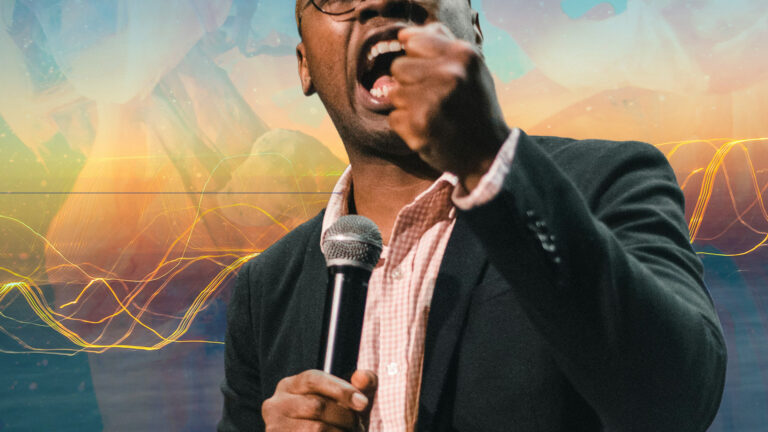

The Nairobi Institute of Reformed Theology exists to equip men and women for faithful gospel ministry. This was a public lecture delivered by Raymond Ndung’u at the Proclaim Conference in 2024.
In this lecture, Raymond reflects on the deep wounds left by colonialism while directing listeners to the gospel as the source of true restoration and human dignity. His call is not for new doctrine, but for faithful biblical truth expressed in a way that speaks directly to African hearts and cultures.
Colonialism dehumanised Africans. To adapt a verse from John’s Gospel, were every atrocity committed under colonialism to be written down, the world itself could not contain the books that would be written. Thankfully, much has changed? But the greatest hope for postcolonial Africa is the gospel. For it is only the gospel that truly humanises people.
However, the African Church must also decolonise Christianity in Africa. There is an illusion in Africa that to become a Christian essentially means accepting Western culture. It’s time that we stopped identifying Christianity with the West. Let the redeemed say so. Let them say it in their own language, glorifying God in their own tongue. Our Lord must be given all that our cultures have to offer so that he can sift out the sinful and we can celebrate aspects that are true and good (Philippians 4:8).
It’s time that we stopped identifying Christianity with the West. Let the redeemed say so.
The call then is simple but crucial. The African Church needs a practical theology that is uniquely African. While the fundamental or core truths remain unchanged, informed and imparted by God’s word, the application needs to be different. Contextual. Pastoral and practical aspects need to be tuned and reconfigured for the African people. Theology needs to meet people on the ground, in the way it teaches them to live for the Lord. The call for African theology isn’t a call for novel theology, but theology’s nuanced implications.
The African Church must be thoroughly African in order to preach the gospel of Christ to the heart of its people, both celebrating and challenging their cultures on the basis of God’s word and the gospel of Christ.
Other Content On: How the Gospel of Christ Humanises the Postcolonial African
Can We Trust the ‘Colonialist Bible’?
African Christianity Thrived, Long Before White Men Arrived
Church History Isn’t Only for Historians and Scholars
Jan Tzatzoe’s Faith and God’s Favour in Colonial Africa
Transcript
How the Gospel of Christ Humanizes the Postcolonial African
It’s a joy, uh, for us to gather here this afternoon—this evening, rather—and a joy for me to speak to us on a subject that is rather touchy to many of us, and yet rather dear, I should think, as we think about ourselves as Africans and even as our visitors, perhaps those who even are members of EBC from the West, as they consider how to think about us. This is a very necessary topic.
And so then, we shall be speaking today on the topic: Neither Indifference Nor Hatred—How the Gospel of Christ Humanizes the Postcolonial African.
Missions and Colonialism
So, you know, Christianity in Africa has had a rather complex history. This is in large part due to complex interactions between missions and colonialism. The missionaries and colonizers landed in Africa around the same time, and they mostly came on the same ships.
And indeed, African Christians blush when they realize the truth behind J.H. Bavinck observation that, “the work of missions was inevitably involved in exerting cultural influence, and frequently missions voluntarily rendered an important service in the process by which the West mastered the whole world.”
And so the complications that arise from the collaboration of these two strange fellows—strange bedfellows—is not hard to discern. Because, on the one hand, missions is meant to be fueled by love and to lead to the wholeness of those who are reached, while on the other hand, colonialism proceeds from hateful pride and leads to subjugation and oppression.
And so, the outcome of this bad combination in Africa has been the illusion that to become a Christian is identical with the acceptance of Western culture. In other words, even in the manner of his evangelization, there is a real way in which the African was not treated as a human being worthy of the dignity befitting God’s image-bearers, as we see in James 3:9–10. The effects of this can still be felt in Africa today.
And these issues have proven to have significant staying power as questions that confront the African church. It is not uncommon to hear those who reject Christianity label it as the “white man’s religion,” or as the “colonial religion.” And for those of us who are Christians, who are Africans, sometimes we have a difficult time explaining to our families how we are not sellouts to the white man.
So, some members of the African church are indeed indifferent to this reality, hoping to move past this awkward history without having to confront it with biblical truth. But others have been active in speaking and writing about it, which has even led to the growth of a unique African theology of liberation, whose center is the question of human dignity and human worth.
Unfortunately, though, many of those who have taken these matters seriously enough to write about them have not rooted their treatments firmly enough on the truths of Scripture. And because we do not want to act as if we are the ones beginning this conversation, in this talk we will seek to engage with one such proponent of this African theology of liberation: Professor Jesse N. K. Mugambi, the Professor Emeritus of Philosophy and Religious Studies at the University of Nairobi, and the most cited scholar at that university. He is one of the leading figures in the development of the Kenyan version of African liberation theology.
So, as to methodology, we shall affirm Professor Mugambi’s denouncement of colonial oppression and injustice. And yet, we will seek to render a biblical critique of some of his assertions and conclusions on how the African church should address the dehumanization of the African.
And so, let us begin by considering Professor Mugambi’s theology of African humanization.
Professor Mugambi’s Theology of African Humanization
Professor Mugambi defines a dehumanizing situation as one in which human beings are hindered from realizing their full humanity. By his assessment, in Jesus’ quotation of Isaiah, Jesus outlined the following situations as dehumanizing ones: poverty, captivity, oppression, prejudice, physical illness, and estrangement from God.
We shall note a bit later on that estrangement from God should feature higher on this list and be given a controlling effect on the entire list. But, that notwithstanding, the professor also devotes specific attention to the dehumanizing effects of prejudice, where he says that, “in a society, one social group regards itself as being superior to others, and on the basis of this assumed superiority discriminates against those people whom it considers inferior.”
He says that, “When a person is forced to feel that he is less human than others because of his ethnic identity, political status, or economic status, he greatly suffers from such dehumanization.”
And so, given his concerns regarding human dignity, it is not surprising then that the professor reserves his harshest criticisms for colonialism, and also for the modern Western missions, for their complicity in it.
So he says that, “Some of the missionary denominations have offered a theological justification for colonialism. How can a theology of oppression and exploitation be compatible with the gospel? How can a theology of racism and militarism be compatible with the gospel of Jesus Christ?”
In another one of his works, he revisits colonial history with a scathing depiction of missionaries’ involvement in colonialism. He writes this. He says:
“When Alexander the Great went out to conquer, he took with him agents to spread Hellenic civilizations, and so conquered cities were named after him, and temples were erected in those cities to sanctify the conquest. The Roman Empire, taking cue from the Greeks, followed the same trend and spread Roman civil religion wherever the Romans ruled.”
And this is what he says: “European empires of the 20th century operated on the same principle, with Christian missionary agencies as the sanctifiers of conquest.”
While this is certainly an overstatement of the unity of purpose between missionaries and colonialists, it does capture some truth insofar as the culture of the missionary, he says, “has been presented in the mission field as the norm by which the conduct of African converts should be measured.”
And so, thus having established the injustices committed against the African during colonialism and the unfortunate collaboration between most missions and colonialism, Professor Mugambi proceeds to instruct the African church regarding the ways in which it should seek the humanization of its dehumanized people.
His first area of instruction has to do with the nature of the Bible and its intended impact on culture. And so he writes:
“The Bible is not a recipe for culture, nor is it a manual for cultural engineering. It is a diverse collection of texts carefully selected and packaged over many centuries through a long process conditioned by a wide variety of cultural factors. The Bible itself is a cultural document created, preserved, and disseminated culturally.”
And so, therefore, he argues that it is the responsibility of African biblical scholars to affirm both the relevance of the gospel and the validity of the cultural and religious heritage of African peoples. Without affirmation of both, Christianity cannot take root in Africa.
As we shall see later, this understanding of the Bible and culture can lead to significant error if not considered carefully. But for now, let us continue to unfold the professor’s exhortations of the African church.
And so, given the centrality of Christ, it is not surprising that Professor Mugambi’s second area of instruction has to do with his understanding of the mission of our Lord Jesus Christ. He maintains here that, “human dignity is a precondition for freedom, and freedom is a precondition for reconciliation. Without reconciliation there can be no genuine peace, and therefore, in the teaching of Jesus, the restoration of eroded human dignity is the first step toward peace on earth and towards the kingdom of God.”
He bases this assertion on the supposed concern of Jesus to inaugurate an era in which dehumanization would be conquered. This is why, he says, the reply of Jesus to the disciples of John the Baptist, when they came to inquire if he was the Messiah, referred to his work in alleviating physical illness among the individuals in his community.
And so, while a thorough critique will be offered later, it would serve us here to note the absence of the death and resurrection of our Lord Jesus Christ in Professor Mugambi’s definition of the mission of Christ and of his gospel. He refers variously to this gospel—in one place—as “the good news of total liberation” (citing Isaiah 61:1–2 and Luke 4:16–22), and in another place as “the good news of salvation-liberation.” And so he sees those two things as being very intimately tied.
In his third area of instruction, and flowing out of his understanding of Christ’s mission, it is not surprising that Professor Mugambi has a lot to say concerning the mission of the church in the world, which he defines as, “a mission of reconciliation and liberation from all forces of greed and selfishness and prejudice that bring hatred and division to the world we live in.” Since, he argues, from the African perspective, liberation in its total sense is the greatest aspiration.
And so then, the church, as a community of the followers of Jesus, is challenged to respond to all dehumanizing situations in a way that its actions speak louder than its verbal proclamations. And so he actually states it categorically and says, “It is not what the Christian churches preach that counts, but what they actually do that bears witness to our commitment as Christians.”
So what kind of action should the church take? I’m glad you asked. In Professor Mugambi’s view, any and every action that aims at liberation is legitimate. He goes so far as to say:
“The issue of violence and nonviolence is a subsidiary one. Survival, freedom, justice, and humanization are logically and theologically prior to the question of violence and nonviolence.”
And, as a matter of fact, in his view, this must be the case, since he says the restoration of human dignity and freedom are preconditions of effective and genuine reconciliation. And so, therefore, there can be no genuine reconciliation between a slave and his master as long as the master–slave relationship is maintained.
And this issue is so important to him that he hangs eternity in the balance. He writes somewhere that “no one can expect to enter the kingdom of God if he does not work conscientiously for peace on earth”—citing Matthew 5:19.
In his view, this must be the case because God, he says, is the ultimate judge of us all, and we are participants in a divine drama geared towards the humanization of those who have been dehumanized. And so, this therefore is Professor Mugambi’s understanding of the mission of the church.
And so, given the professor’s prominence in many theological circles in Kenya—and if you’ve been in any of those conferences and forums, you have heard these things being said—and so, therefore, having noted his key theological perspectives and assertions, we are now ready to offer a biblical critique and to suggest a better way forward for the African church.
Biblical Critique
So, here then, is a biblical critique of Professor Mugambi’s assertions on African humanization.
A biblical assessment of Professor Mugambi’s understanding of theology and its application to the dehumanized postcolonial African must begin by affirming the professor’s positive concerns. Here we must acknowledge the shortcomings of modern Western missions, particularly regarding their tendency to undermine African cultures and to declare their totality as irredeemably pagan.
So, we agree with Professor Mugambi’s assertion that the role of the missionary ought to be to help the converts to constructively criticize their own cultures in order to improve them, not to undermine or destroy them. Indeed, in the same way missionaries have appropriated the Bible in the context of their respective cultures, so should African Christians appropriate it in the context of African culture.
So, the imposition of Western language and culture upon the African was one of the saddest elements of the manner in which missions were conducted. It proceeded from a prideful sense of superiority by the West, who did not take time to know and love the African as African—to learn their languages and discover why, in their cultures, they did the things they did—in order to address those cultures with the gospel and to help them to love the God and Father of our Lord Jesus Christ in their own unique ways, and pray in the Spirit in their own languages.
Instead, as J. H. Bavinck noted critically, missions were conducted in such a way that it created the illusion that to become a Christian is identical with the acceptance of Western culture. Thus, Professor Mugambi’s criticism of the modern missions movement—while sometimes overstated and exaggerated—has a lot of truth in it, since it dehumanized the African by not engaging his culture with the gospel, because the African’s culture was considered to be second-rate, uncivilized, and irredeemably pagan.
However, having registered this agreement on the nature and severity of the problem, we must then proceed to register deep disagreement with Professor Mugambi’s proposed solutions. It is our contention that Professor Mugambi’s handling of the problem is insufficiently biblical, especially in his failure to develop a theological anthropology of the African and to fully appreciate the nature of Christ’s salvation in order to apply the gospel properly to the African.
So we shall therefore develop these two in turn as the foundation of a better theology of the humanization of the postcolonial African.
So, we begin here with a biblical theological anthropology of the African.
Biblical Theological Anthropology of the African
When considering the African, we must begin by asserting that he or she is created in the image of God. Unfortunately, this point has been contested in the past by those who twisted scriptures and used bogus science to claim that, “the Negro has smaller brains, less intelligence, and lower capacities for advanced civilization.” Others claimed that dark skin was a sign of being cursed, some even claiming that the mark of Cain in Genesis 4 was dark skin—God cursed Cain by making him African.
But many more actually justified the enslavement of Africans on the basis of the supposed curse of Ham in Genesis 9. And so, as a response, theologians of African descent sought either to convince their readers of the Negro’s true potential, or to mount a counter-offensive in the name of black theology and black power.
Professor Mugambi, who we have been quoting, would belong to the latter kind of theologians—those who have sought to mount a counter-offensive by articulating a very pointed and potentially violent theology of liberation.
But these are not the only options. It is not a must that the African choose between self-justification on the one hand and retaliation on the other hand. Instead, if we are to think biblically, we must realize that racial prejudice is sinful, and is therefore first and foremost an affront against God himself. Specifically, racial prejudice refuses to recognize—or at least to honor—the divine image in another human being.
That the African is created in the image of God is a biblical assertion and an article of faith. It rests in the creation of all peoples from the one man and the one woman, Adam and Eve, as Paul says in Acts 17:26, and all scripture bears witness to.
Even though Darwinian evolution has made it plausible to denigrate the African by claiming that he or she is closer to the ape than the Caucasian is, biblical faith asserts that all people share in a common humanity. Indeed, as Herman Bavinck notes, “the unity of the human race is of utmost importance. It is the presupposition of religion and morality. The solidarity of the human race, original sin, the atonement of Christ, the universality of the kingdom of God, the Catholicity of the church, and the love of neighbor—all these are grounded in the unity of humankind.”
And so, therefore, to assign differing degrees of humanity to fellow man is to sin in a very egregious way. Those who do this deny God the glory due his name. For God must be glorified for all that he has made. In the case of humanity, God must be glorified for his design of the African every bit as much as he is glorified for his design of those of European descent.
Indeed, this appreciation of God’s beautiful artistry must inform our view of all people everywhere. This, therefore, must be the starting point for understanding the African—that they are made in God’s image for God’s glory.
But besides being created in the image of God, the African must also be understood as a fallen human being. And this is an aspect that is sorely lacking in Professor Mugambi’s estimation of the African. As a fallen human being, the African is in desperate need of God’s grace. This is the case with all people—Africans, Asians, Europeans, and so forth.
All of us are sinners in Adam who need to be forgiven, rescued, and redeemed. We are enemies of God who need to be reconciled. We are under God’s wrath, needing propitiation. We are dead in sin, needing regeneration. We are under sin, needing sanctification. In sum, we need God’s grace in Christ Jesus. This is true for all humanity, and it is certainly true for the African.
Therefore, having developed this biblical-theological understanding of the African as one made in God’s image, and having explained our absolute neediness before God, we can now proceed to a biblical understanding of the gospel and its application to the African.
And it is to this that we now turn—the true nature of Christ’s gospel and its application to the African.
You see, while Professor Mugambi lists dehumanizing situations as poverty, captivity, oppression, prejudice, physical illness, and estrangement from God, and claims that Jesus came to inaugurate an era in which dehumanization would be conquered, it is clear that he does not pay enough attention to the dire need of humanity as sinners before a holy God.
While he claims that, from the African perspective, liberation in its total sense is the greatest aspiration, he is wont to think about this liberation in purely horizontal terms, and neglect the truest sense of liberation that the African needs—that is, to be freed from the condemnation and power of sin, and to be reconciled to God through Jesus Christ.
This is why he sees Jesus’s ministry as primarily a ministry concerned with alleviating suffering, while never really drawing attention to the Lord’s death and resurrection. This is why he sees entry into the kingdom of God as a reward for pursuing peace on earth, since this is how he understands the church’s call to image Christ.
In all these aspects, Professor Mugambi proves himself not to have considered the African’s plight in a sufficiently biblical light. But instead—since the African’s plight is so bleak, as is that of all peoples—the African’s only hope is the true Jesus of the Bible, the God-man whose mission was to rescue his people from sin (Matthew 1:21). Through his ransoming death (Mark 10:45) and his justifying resurrection (Romans 4:23–25), the African’s only hope is to repent of their sins and to believe in this Jesus.
The African’s highest aspiration must be adoption by the Father, union with Christ, and fellowship with the Holy Spirit. We must not run counter to Christ when he specifically maintained that “my kingdom is not of this world” (John 18:36).
And so, the African church must beware of the danger of rejecting Jesus of Nazareth for the same reason the Jews rejected him—and that is, the desire for a political liberator.
And so, it is true that colonialism and slavery are deeply troubling and dehumanizing. But our Lord Jesus offers more than a better station in this passing world. He offers true riches in his true kingdom, which he has inaugurated through his death and resurrection, but which he is yet to consummate at his return. This, then, is the true hope for the African.
So what does this mean practically for the postcolonial church in Africa? Let us now consider the biblical applications for the postcolonial, dehumanized African.
Biblical Applications: Prioritize the Gospel
A lot can be said at this point, but we shall offer three major suggestions for how the church in Africa should proceed in its reflections upon the dehumanizing effects of colonialism, slavery, and racism in general.
The first thing is that Africans must discern their truest need. As discussed earlier, the African is made in God’s image but has fallen into sin in Adam. As a sinner and an enemy of God, the African’s deepest need is neither financial nor material, but spiritual. It is the need to be reconciled to God through Jesus Christ (2 Corinthians 5:19–21). And thus, the church in Africa must learn and preach the gospel of the crucified and risen Savior, and call its hearers to faith and repentance so that they might be saved.
And in this regard, the African church must certainly be thankful, because with the Western missions—despite how flawed they were—God actually used them to cause the evangelization of Africa, and many of us are seated here because, and as a direct result of, those Western missions.
And so, even though the African church can decry some of the ways in which those missions went wrong, we must not lose sight of the fact that we sit here now as believers in Jesus Christ because he used those missions, and we must give thanks.
But, on the other hand, with this most important foundation of the gospel laid, the African church must also realize that this emphasis on faith in Christ does not undermine the sense of injustice felt in the face of colonialism and racial abuse. And that’s the second major suggestion we offer: the African church must respond to colonialism and racial abuse in a biblical way.
Biblical Applications: Respond Biblically
So, the first thing was: prioritize the gospel.
The second is: respond biblically.
And here we suggest three biblical responses:
1. A faith-filled repentance.
2. A trust-filled lament.
3. A Christlike forgiveness.
And we shall unfold each of these as we proceed.
So, the first biblical response to colonialism sounds counterintuitive, but the African church is called to a faith-filled repentance. We must indeed note that it is dehumanizing to have our humanity questioned, and it is deeply hurtful to have our appearance ridiculed and denigrated, our capacities questioned and underestimated, our economic situation exploited and mocked.
But despite all of this, the African must first believe for themselves that they are made in the image of God. We must sing with the psalmist in
Psalm 139:13–16:
“For you formed my inward parts;
you knitted me together in my mother’s womb.
I praise you, for I am fearfully and wonderfully made.
Wonderful are your works;
my soul knows it very well.
My frame was not hidden from you,
when I was being made in secret,
intricately woven in the depths of the earth.
Your eyes saw my unformed substance;
in your book were written, every one of them,
the days that were formed for me,
when as yet there was none of them.”
You see, the African is not a remnant of the evolutionary process. He or she is not a sample of the elusive “missing link” between apes and human beings. The African is not a product of divine inattentiveness, nor is he or she a flaw in the Creator’s design, like a house built with dark, overcooked bricks, with the plaster having been forgotten.
No—the African is fearfully and wonderfully made – the product of God’s majestic design, attentively crafted. All human beings are, and the African certainly is.
Therefore, when contemplating colonialism and racism in general, the first step for the African church must be to repent for their own self-loathing. All human beings sinfully look in the mirror and think, “God made a mistake.” There’s always something we are tempted to look at and dislike about our bodies. This is the same for the African as an African. Whatever flaws we think we see in the mirror are the sinful impositions of the fallen human mind upon God’s glorious design.
And so, the African church must recognize this about itself in a world that regularly speaks to the opposite effect: We are fearfully and wonderfully made. And so, African hair is beautiful. Dark skin is beautiful. Dark ladies are beautiful. Why? Because “Wonderful are your works, O God.” And like the psalmist, our souls must know this very well.
Thus, the church in Africa must repent for believing its own self-estimation and that of the world, instead of hearing God’s voice as he rejoices over all that he has made, and specifically also over his design of the African.
So, following this faith-filled repentance, the next response Africans must develop in the face of colonialism and racism is the grace of trust-filled lament.
As we noted earlier, it is a deeply wounding thing to have one’s humanity questioned. But instead of following Professor Mugambi in his call to liberation, which gives an allowance for potential violence, God calls us to lament together with the saints in Scripture, because injustice is sadly a reality in this fallen world.
Oh, how many should be the cries of the African heart to God concerning our sorry estate in this world! We must learn the language of lament: “How long, O Lord?”
When we consider the unprovoked aggression of colonialism, when we think about the slave trade, even modern-day racism, and even neo-colonialism—where in many countries in Africa, we still see the effects of plunder, genocides, and civil wars that are fueled by input from elsewhere in order to keep the countries unstable—when we look at all of this, we must learn to cry to the Lord in heartfelt lament.
Furthermore, we know that God hates oppression and injustice. So, instead of turning to the sword, we remember him who tells us: “Vengeance is mine; I will repay, declares the Lord.” And thus we heed the call to never avenge ourselves, but instead to love our enemies and to do good to those who oppress and persecute us. For in so doing, God says in his Word, “You will heap burning coals on their heads” (Proverbs 25; Matthew 5; Romans 12).
And indeed, we even evangelize those who hate us. Thus, the church in Africa must not endorse those who claim we should also colonize the West in order to “get even,” because reverse colonialism is colonialism, and it is sinful to repay hatred with hatred.
Thus, the African church must trust that “Blessed are those who mourn, for they shall be comforted” (Matthew 5:4). This includes both mourning for the sin in our hearts—and thus the repentance we saw in our first response—and mourning for sin in the world—and thus the lament in this second reaction.
But this applies not only to the colonialism of the past, but also to present-day racism in the world. We know that there are many who do not dehumanize Africans, but we also know that there are many who do dehumanize Africans—like those football fans in Spain and Italy who utter monkey chants at professional footballers because they are of African descent. Indeed, there are those whose hatred is overt.
And yet, even in the face of overt racial abuse, we must trust God to repay. We must never avenge ourselves.
This is another area in which Professor Mugambi proves to be insufficiently biblical. Because according to God’s Word, avenging oneself is evidence of unbelief. It is the implicit claim that God either does not care or cannot act.
But we must believe that God will repay every injustice to its fullest extent—either by turning that person to repentance, in which case it is paid for at the cross, or he will meet with wrath every insult and every denigrating thing that has been said, as he meets out justice on his enemies. And thus, the African church must lead the way in entrusting ourselves to the one who judges justly, even when we are reviled and maligned (1 Peter 2:21–25). For to this we are called, and for this we are empowered in Christ Jesus.
The third biblical response, after repentance and lament, comes in the form of Christlike forgiveness—particularly for those within the church. For believers within the church of Christ, racism must not be treated as a peculiarly unpardonable sin. Christ’s instructions for his church apply here just as elsewhere:
“Put on then, as God’s chosen ones, holy and beloved, compassionate hearts, kindness, humility, meekness, and patience, bearing with one another; and if one has a complaint against another, forgiving one another, as the Lord has forgiven you, so you also must forgive” (Colossians 3:12–13).
As we have observed above, racial prejudice is sin against God. It is his image in people that we undermine when we commit this sin. In this sin, we bless God and curse those who are made in his likeness (James 3:9–10). And these things ought not to be so.
It is indeed a grievous sin. It is a serious sin. It is a deeply hurtful sin to the neighbor against whom we have committed it, because we undermine their humanity. But it is not the unpardonable sin. There is more grace in Christ than there is racism in the most hardened racist.
And in the church of Christ, we have people coming together from all walks of life. As it has been proven from Scripture and from our own experience, God saves wretched sinners—and all of you are evidence, and so am I.
And so, some of those who are redeemed will have been outspoken racists in the past, while others would have harbored silent biases in their hearts and sinful assumptions concerning their fellow man.
We must also note here that Africans also commit this sin against themselves and others, to say nothing of the reverse racism the world commends when it claims that it is okay for Africans to hate those of European descent.
So how are we to deal with this sin when it is committed against us? We must forgive each other as God in Christ has forgiven us (Ephesians 4:32).
In Christ Jesus, the African is united to the European man and woman, the Asian to the Latino, the Native American to the Eskimo, and so on and so forth. As Galatians 3:28 notes: “All are now one in Christ Jesus.”
And in the church of Christ, we can have no excuse to introduce disunity between those that Christ has died to unite. So this means that the racist must repent of their racism. But it also means that the African must be ready to forgive even an explicitly racist remark. And this is indeed difficult. But since God has forgiven us much, we too must forgive. And by the sanctifying power of the Holy Spirit, indeed we can forgive.
There must be grace in the church of Christ for someone who grew up with racist assumptions to progressively learn the truth of the worth of all people as being made in God’s image and the need to love all people as an outworking of their faith in Jesus Christ. Such people will not change overnight. And the African church must not Christianize the godless cancel culture. And thus, even in this personal area, the church of Christ must be marked by love and forgiveness.
Indeed, “By this will all people know that you are my disciples, if you have love for one another” (John 13:35).
Biblical Applications: Honour African Languages and Cultures
The third major suggestion then for the African church, after putting the gospel first and reacting biblically with repentance, lament, and forgiveness, is this: we must honor our languages and cultures and not give them up as irredeemably pagan.
For example, here in Kenya, we must not imagine that godliness is tied to how well one speaks in English or lives like a Westerner. That’s interesting, isn’t it? We laugh at those who can speak English fluently but not their own languages – I mean, rather we laugh at those who speak their own languages well but English poorly. It’s like that’s inverted, isn’t it?
We must honor our tribal languages and seek to preach and teach and write in them. The African church must not imagine that Africans ought to be transitioned out of their languages and cultural milieu so that they can be taught the true gospel of Jesus Christ. This indeed does not mean that we give the gospel and African culture equal weight, as Professor Mugambi seems to suggest, but it surely means that we must not discard African cultures in their totality.
As J. H. Bavinck noted:
“The Christian life does not accommodate or adapt itself to heathen forms of life, but it takes the latter in possession and thereby makes them new. Christ takes the life of a people in His hands. He renews and reestablishes the distorted and deteriorated. He fills each thing, each word, each practice with a new meaning and gives it a new direction.”
In other words, the African church must decolonize Christianity in Africa. Our Lord Jesus Christ must be proclaimed in the purity of His gospel to the African people as Africans. Our Lord must be given all that our cultures have to offer so that He can sift out the sinful and fill with true biblical meaning those elements that mimicked the truth without having their unifying center in Him.
We must not imagine that to be truly Christian is to sing like Westerners or speak or teach like them. Let the Westerner glorify God in their own form and language, and let the African glorify God in their own form and language.
For truly, it redounds to the glory of Christ that “He has ransomed people for God from every tribe and language and people and nation, and has made them a kingdom and priests to our God, and they shall reign on the earth” (Revelation 5:9–10).
So why should Owamon not be a baptismal name? or Mũi or Kimanii or Irũng’ũ or Geraldish or Legishon? Just to name a few? And it’s about time that we stopped identifying the Christian with the Western. Let the redeemed say so, and let them say it in their own language, glorifying God as the one who has redeemed and owned every aspect of their lives and cultures.
This is important in affirming the humanity of the postcolonial African. It affirms them as people. Not everything you guys used to do was absolutely wicked and needs to be done away with and replaced with this new thing. No. How does Jesus address what you were doing? How does He talk about the things that you have been practicing?
So this, therefore, is the call that this talk is designed to make. The African church needs a practical theology that is uniquely African. There would be no difference in exegesis, in biblical theology, in systematic theology—no difference at all, except maybe in the language used. But it must be uniquely African in its practical and pastoral aspects: in the way it meets the people on the ground, in the way it teaches them to live for the Lord. It must be uniquely African.
For instance, the church in Africa must develop a theology of bride price and dowry processes instead of merely copying what the West does. Additionally, we must stop calling the European white wedding the “Christian wedding.” It’s not. It’s not prescribed in the Bible. I’m pretty sure that’s not how guys in the Bible used to marry each other. And so, a Kikuyu rũracio can be done in a deeply God-glorifying manner. And that would be the Kikuyu Christian wedding.
This is what it means for Christ to take possession of all that is African and redefine it for His own glory. And so the African church must do the hard work of determining what this looks like—for the glory of God and the joy of every African believer.
And what is at stake here, by the way, brothers and sisters, is not merely reclaiming our Africanness. No. It is nothing short of us offering our whole selves to the Lord Jesus Christ. Many of us here have the experience of family functions where we start with the Christian things—we sing, we read the Bible, and then we hear it preached. And then we do now the African thing.
But the question is this: why can the two not mix? Why must the two remain separate? Is the African completely incompatible with the Christian? Or is it just that we have not thought deeply and biblically enough to bring the two together and let Christ reign over all things?
So again, my job here today is to sound the alarm that J. H. Bavinck sounded all the way back in 1960 when he wrote his book—I love that book, would recommend it heavily—An Introduction to the Science of Missions: that if we are not careful, believers in a city like Nairobi will be foreigners to our own people. Think about that.
A Kalenjin living in Nairobi who cannot preach the gospel in Kalenjin effectively locks himself—or herself—out of the opportunity to evangelize their own people. How will our people hear the gospel?
Again, if all students at NIRT are speaking and writing in English, how will the true gospel get to our villages? How will they hear? If we think that Reformed theology must be contained in English, must be spoken, theologized in English—what about the Luo’s who cannot read English? And that, by the way, is the majority. How will they hear the truth of Christ?
We were talking this morning with a pastor friend, and the reality is that the prosperity gospel does not need much to spread. It doesn’t take much to tell someone that believing in Christ will make you rich. It doesn’t take anything to teach them to speak in fake tongues. They don’t even vary the tongues based on your languages. It’s the same thing. You just teach one format, and it cuts across the whole of Kenya.
But it takes a lot for the truth of Christ to get to people so that, as Tim has told us, they may not only know about God but actually know Him. It takes a lot. And those people must be addressed in languages they can understand—the language that they think in, that they imagine in, that they dream in. That must be the language with which they are called by Christ.
And who will preach it if all of us are here just wanting to speak more English? English is nice. I’m speaking in it. But if all of us imagine that that’s what growth in Christ looks like, we will be foreigners to our own people.
And so this is not merely a cultural conversation. It is a concern for the Great Commission and for the worship of God amongst our own people. The church in Africa must be alert to these dangers.
We here in Kenya sit 61 years after independence, and we really are at a crossroads. As a Kikuyu, I feel it, because many of my people are going back to the African traditional religions. And so now, if all the Christians—if all the Kikuyu Christians—do not know a word of Kikuyu, who will actually preach to them? So now we stand at a crossroads.
And if the Christians go the Western way and the Kikuyus go the Kikuyu way, we will be foreigners to our own people. And it’s the same thing that’s happening with every other tribe, isn’t it? The guys growing up in the villages and you growing up in the city—you guys can hardly have a conversation.
And so we must be alive to this. We must be alert to these dangers. Doing our theology in our local languages so as to reach our own people and speaking and writing on cultural questions that will never be addressed by books from the West.
When was the last time you saw a book by John Piper on witchcraft?
I bet you never have, and you never will. Not because he is negligent, but because it’s just not a question he’s wrestling with. And yet your people are.
Indeed, if the church in Africa is to truly reach its people, it must begin by truly loving them and addressing them as they are.
True Heart Change
I would like to finish here by quoting J. H. Bavinck at length concerning the danger of missing the hearts of the African people when we do church in Western forms and languages. This is what he says in a book in 1960, sounding out a very timely warning.
He says that
“Christianity is considered to be the religion of the West and therefore must be preached in a Western manner.
There is, however, reason to fear that in this way the gospel does not penetrate deeply into the heart and thought of non-Western people. It does not reach the depths of a person’s soul. It does not set a person’s thought in motion.
It can then be the case that within the very depths of a person’s heart, he still secretly holds on to all sorts of old magic and mystical conceptions which he has never completely conquered.
What we have said also holds with respect to the educated people of Asia and Africa who have already made Western science and culture their own—for they have made it their own mainly in a rational or intellectual sense.
It is very possible indeed—and with respect to millions of people today, it is even very certain—that in their deepest parts, in their hidden emotional life, there is still very much that binds them to the old mystical, magic view of the world.”
And thus the African church must be thoroughly African in order to preach the gospel of Christ to the heart of its people, and to address and challenge their cultures and lifestyles on the basis of the Word of God and of the gospel of Christ.
I give here an example of our pastor Lemayian. I hope he doesn’t mind me using it. I had not asked him beforehand. He’s coming here to question—perhaps he’ll unleash the fury. But yeah, uh, when he was preaching on Ephesians 6 here at EBC, he actually made an off-the-cuff statement and said, “Because Christ has won over the powers of the devil and over evil, then you should not fear witchcraft.”
And he actually—he admitted this to me—he just, I said that just in case, you know, like, I don’t expect that at EBC there would be any such problem, but it’s helpful to say that. But after the service, someone actually walked up to him and said—and this is a person who had lived in Nairobi for over 10 years—but the person was saying: “My grandmother was a witch doctor, and she told me she had cursed me. So for over seven or so—10 maybe—years, I have been living in fear. I know Christ has won, but I needed you to say that. I needed you to say that Jesus has overcome all of the powers of the enemy, and I am safe in Him.”
So that’s what we risk when we speak and think in Western forms when we are holding and preaching the gospel. We don’t actually talk to our people.
And so, in conclusion, our talk today has offered a biblical critique of Professor Mugambi’s vision for the humanization of the postcolonial African.
Africans are a real people with a real heritage. It is a sinful heritage, but one that Christ died to redeem and demands to be submitted to Him—not despised and discarded. And this is the proper way to do African theology. It is recognizing the problems raised by Professor Mugambi, but charting a more biblical path for the African church, which prioritizes the gospel, responds biblically in repentance and lament, forgiveness in the face of colonialism and racism, and redeems African culture by aligning it with scripture for the glory of God in Christ Jesus.
Indeed, let the redeemed in Africa say so.
Thank you.
Interview
Interviewer:
Thank you so much, brother. Give you a moment to breathe, catch your breath. Uh, someone said, “This is a well-written paper. That’s it. I have no question. Thank you. Just highlighting that this is great content.” Thank you, thank you for encouraging our brother.
Just talk to us briefly about the process of writing this paper. So, this is your term paper that you’ve modified for this talk. I was there when Dr. Chris was giving you guys this assignment—asking for bibliographies and telling you the scope within which your paper should fall. But briefly, for two seconds, how—what that’s like?
Speaker:
Oh, wow. Uh, it was tough. Yeah, it was tough. Initially, just at sea. I knew I wanted to write on the African and the image of God, but you know you need to work with resources that exist—and not many people. So, in the 18th century, guys were really writing on whether the African is made in the image of God. A lot of it—very disheartening. I’ve cried quite a bit when I’ve read that.
But then the question was, like, how do I make that relevant today? And so, it was quite the journey in trying to—oh, maybe this person talks about it—but then I ultimately thought, “Ah, there’s all this liberation theology which is a response, a reaction to that. So, let me actually engage in the conversation as it has been heard in Kenya and in Africa as well, and think through biblically what that looks like.”
So, yeah, found him, you know, on the internet. He’s very widely quoted—Professor Mugami. Read a bunch of his books. Um, and so yeah, just thinking through also how to frame what he’s saying.
Because, you know, he wasn’t writing in this format, so he’s saying different things in different places. You’re trying to think, “Okay, how can I present his view in a logical way that is well understandable?” So, it’s a hard process, but thanks be to God. And um, I think as well, just engaging with him was really edifying.
Interviewer:
No, yeah. Thank you for speaking about him and engaging him in charitable ways. It feels as if someone had not heard about Professor Mugami—and some of them might have their hand up—that they got a good, comprehensive introduction to him, a good idea of the scope of his work. And then it didn’t feel as if you’re just criticizing someone, just cascading, throwing them away, but actually mentioning where he’s coming from, what are his strong points, and what are ways in which he is clearly unbiblical.
So, thank you so much for showing us that. And I think in that way you have covered a lot of unbiblical sentiment that we may not put in the same language as Professor Mugami, but we might sense in our own hearts.
Yeah. I thank you for highlighting Nairobi as just this special case. And several people are from different countries here. I know there’s people from Kampala and other cities of Africa. And one of the things that J. H. Bavinck highlights—as you said in his book—is how cities like Nairobi end up having this third kind of culture. So, it’s not a Western culture, it’s not an African culture—it’s this third kind of culture.
And there’s a sense in which the church already comes to preach to people who are coming from that third culture. So, what is your counsel to churches in Nairobi? Are you encouraging Christians in that third culture to sort of step away from that third culture and go back to the second culture of either being African, or, you know…?
Speaker:
Yeah, no, that’s a really useful question. I think in the book J. H. Bavinck is really helpful. He actually mentions Nairobi by name as one of those just strange cities.
Um, so—1960, 1960, 1960—it tells you, man, just things don’t change that much. Um, so yeah, I would not necessarily be advocating a going back, but just an awareness is helpful, you know.
So, the thing is, guys in Nairobi—and not the thing, even with Nairobi itself—is Nairobi itself is interesting. Like guys in this area speak in English maybe majority of the day, walk down to Kangar and know English or Swahili. So even Nairobi cannot be taken lump sum like that.
And so that’s what I’m saying. Like the guys here who have been way more Westernized need to be aware that if the gospel is going to get to your people, you will need to do some work, you know. You will need to learn your own languages in order to be able to engage with your own people, which is something you may not need to do on a day-to-day basis if you live in maybe the Lavingtons, the Karens etc.
So, not so much a going back as if, like, when your boss asks you something in English, you say it in kiSwahili because you’re an African. No, I’m not saying that. But at least the awareness is helpful in terms of just not at least killing the implicit pride in the fact that you don’t speak your mother tongue.
Like, so, like—that’s something that should make you ashamed, you know. So, yeah, at least take that shame to the gospel. Yeah. And Christ died for that. Christ died for that. But it is something at least to be addressed in that way. You know, it’s sort of water we are swimming in. You’re trying to point it out: “Hey, there’s water.” So that you know where the currents are, and try to start to imagine a different way of swimming as you are in the waters.
That’s one. Uh, two, I think that for NIRT, which is, uh, by God’s grace such a blessing—that we get to study theology at such a high level—um, for guys who are coming in, I pray that the Lord would give my efforts fruit. I try to just keep constantly nudging the guys who are coming in to not be western-facing.
So, when you’re coming into NIRT, you have those heroes of yours, right? You read akina Sinclair Ferguson, Akina John Piper, etc. And Crossway will actually be at the conference from tomorrow—getting in from tomorrow.
Interviewer:
He’s getting in from tomorrow. So, continue.
Speaker:
Yeah, yeah. I’ll make sure to say all of the dirty stuff now. But anyway, so guys coming in to study theology can have a very western-facing mindset. Like, “When I’m studying theology, it’s so that I may be able to speak into issues in the western church.” You know—you’re hearing perhaps their discussions, maybe with Akina Dever and then Akina MacArthur, and you’re like, “What would be my take there?” Right?
And yet, the guys in your village are actually genuinely wrestling with things that you could help with, right? So, the prayer then is not to be as western-facing, but actually to face our people—to do theology thinking about the practical issues guys in Kenya face that are not faced in the West.
And so for us in Nairobi again, that third culture thing—we can face the West or face inland. And the call is: face your people, talk to them, learn those languages. Some of us might need to start learning our languages in adulthood, but that’s helpful. Because then we will be more useful in the Great Commission to our own people, right? Yeah.
Interviewer:
Because you’re not just saying, “Let’s just learn it because every anthropological class is doing that,” but you’re saying, “Learn because it’ll make you more useful in the place that you already are.” Yeah.
Speaker:
And the thing is, how many people do you actually meet that you can comfortably evangelize in English—even in Nairobi? Not many. But how many people do you meet that even Swahili would actually really give you a good opening—with many of your house helps, many of the guys that you interact with?
And so yeah, that’s a shift that needs to happen. That’s two.
But then three as well—for guys who are studying theology—uh, there’s a book that has been really helpful: The Rise and Triumph of the Modern Self by Carl Trueman. He writes about the things that have shaped western culture, and it’s so insightful for those who have been affected by western culture, including us of the third culture.
But the thing that really bothers me is: I know that I am affected by my African culture, but I don’t know how. And that’s the thing that so many of us— even in our marriages—the way you imagine the man of the house should behave and the way that God talks about it in His Word, I have discovered, is very different. Because I was really shaped by the communal sense of what male and female relationships are. But now I’m getting that, “Wow, actually there are problems there.”
But it hasn’t been described in a way that actually brings them to the fore. We just live experientially as Africans who have been westernized. And so we can more readily pick up on the western things and how they influence us—the sexual revolutions, and so on. But the African things—those are the things that we do, right? Just instinctively.
Yeah, we do that, and you’re like, “Why did I do that?” You know? But it’s because you grew up in an African home with African assumptions that you have not actually thought through biblically.
Interviewer:
Yeah, that’s good. Uh, last question and then we’ll go to our tea break. Could you help someone who is wincing at you saying that the African church must be thoroughly African, when they’re going, “Shouldn’t you be saying it should be thoroughly biblical?” So maybe help that person with what you’re not saying.
Speaker:
Right. Yeah. Right. So yeah, what I’m not saying is that the African culture can be raised to the point where you’re thinking, “Bible and African culture,” and it’s sort of a negotiation. That’s exactly not what I’m saying.
But what I am saying is—as something that is submitted underneath the authority of Scripture—the African culture is to be addressed, not run away from. You know?
So that interesting mix of colonialism and missions made it such that—the first schools obviously were teaching English, right? And the first guys who were evangelized were evangelized as those who had been taught English.
And so, to grow in your grasp of English was also to grow in your grasp of Christianity, because you’re reading the Bible in English. And so it was like: the more English you knew, the more you could read the Bible, right? The further away you are from English, the further away you are from…yeah.
Speaker:
Yeah. And therefore, the more mature of a Christian you could be—before the translations to our languages were done. And so that sort of stuck.
And what we are seeing is that pull towards English forms—sorry, western forms, western ways of thinking. For instance, even something like… this discussion—I forget the name. Sorry it’s gone. It’s the discussions guys have about inter-religions.
Interviewer:
Interfaith?
Speaker:
Yeah, yeah. Defending Christianity. That name is here, it’s gone…
Interviewer:
Apologetics?
Speaker:
Apologetics! We would lose charades! I know, I know. May that be struck off the record. NIRT is much better at this. This, I brought into school—I didn’t learn them.
But yeah, even our apologetics, for instance, right? We can think that many guys are wrestling with atheism, etc. But actually, the things that guys are wrestling with is just ATR, you know. So, even the apologetics we do—we can have a very western understanding of what it means to defend Christianity.
But actually, for many of us, when you go to your uncles and aunts, the things you need to defend Christianity against is a claim that it’s a white man’s religion. “Our people also had God. Why are you saying that our God is not God?” Right?
And so things like that are what I mean when I say it must be thoroughly African. And I clarified that by saying: it doesn’t affect the exegesis, nor the biblical theology, nor the systematics—just the practical and pastoral theology. Where it meets the people—that must be super African.
Interviewer:
Amen. Now, just to illustrate that with this class: so, you guys are students. I sat in three or four of your classes. I mean, the classes were thoroughly biblical—you were hearing from scholars from different parts of the world. But then the papers that you guys have written all have to do with the context that you’re in—including this one.
And that class has enabled you to write this paper that is, I think, helpful to us as Africans. Thank you so much, brother, for your work.