

Excellent Reformed and Evangelical conferences are held across Africa every year. The TGC Africa Podcast showcases select conferences to encourage and build up the local church across our continent.
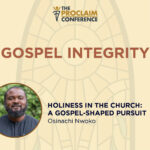
This sermon was one of eight, delivered at the 2025 Proclaim Conference, which is hosted by our Kenyan council member Ken Mbugua, Emmanuel Baptist Church, and Ekklesia Afrika. The conference’s theme and title was Gospel Integrity with each sermon making a case for how the gospel of Jesus Christ revives and reforms the Church today.
To join the TGC Africa WhatsApp Channel please follow this link and click on follow.
Surrounding the word holiness is much misunderstanding. For many people, holiness is the result of keeping a moral checklist, do’s and don’t. Others associate holiness with unpleasant and self-righteous people, who’re always looking down on others. This confusion exists among believers too. Added to it, many Christians understand holiness to mean moving beyond grace; they fear that an emphasis on holiness fosters legalism and pride. In other words, many Christians worry that focusing on personal holiness undermines the gospel of grace.
However, grace isn’t at odds with holiness. Pursuing holiness doesn’t mean graduating from the gospel. In fact, holiness is an expression of our continued trust in God for grace. As our preacher, Osinachi Nwoko, puts it: “The same gospel that informs our entry into the kingdom informs our living in that kingdom.” Holiness flows from the gospel. A lack or indifference to holiness, therefore, raises questions about someone’s experience of God’s grace.
Holiness is the adornment that displays the gospel in all its glory.
Consider Osinachi Nwoko’s beautiful conclusion. In his words, “The gospel lifts the burden of thinking that it is our holiness that unites us to Christ. The gospel is precisely what God has done—what the Father has done in his Son. And so, we are not burdened to attain union with Christ. It is from a position of rest that we give ourselves to this pursuit. So, we are truly reformed and revived as we constantly dwell on that; that we can go to Christ, that we can constantly seek his face, even cognisant of our remaining sin, pleading his cause, knowing full well that that union is indissoluble. It is with that confidence that the church is encouraged to walk in holiness.”
The Church can pursue holiness because we know we are perfectly united to Christ forever because of his grace in the gospel.
Other Content On Holiness In The Church:
The Centrality of Character to Preaching
Prioritise Christ and Your Character
It’s No Surprise to Me I Am My Own Worst Enemy
Faithfulness in the Humdrum
Transcript
Holiness In The Church
It is an honor to be here amongst you and it’s not lost on me that some might find it weird that a Nigerian is in such a church, because when we think of Nigeria, we think of a certain ilk of people and so this could be a hit or miss. Let’s pray that it is not a miss.
Yes, we’re known for trafficking in the word of faith, prosperity gospel. But I think it’s important we bear in mind that where there is, where there are no importers, there are no exporters. So obviously what is being exported has already recipients and so do not blame us for all that carnage.
It is a wonderful privilege to be amongst you, to be speaking to you and whilst I would have preferred not to start the conference being the first time that I’ll be speaking here, I think I understand the wisdom given the subject that we are about to address.
The subject that has been assigned to me and you have that in your program manuals the title is: “Holiness in the church – How the gospel shapes our view of holiness and revives and reforms the church.”
Permit me to read in your hearing Ephesians chapter 5:25- 27. Ephesians 5:25-27 which will serve as the main text for this first address.
I’m reading from the New American Standard Bible.
“Husbands, love your wives just as Christ also loved the church and gave himself up for her so that he might sanctify her, having cleansed her by the washing of water with the word. That he might present to himself the church in all her glory, having no spot or wrinkle or any such thing, but that she would be holy and blameless.” (Ephesians 5:25-27)
May the Lord add his own blessings to the reading and hearing of his word. Amen.
Shall we pray?
Our father in heaven, we’re thankful for your mercies to us. We’re gathered this day and the subsequent days to proclaim your name, the fame of your name, to exalt your Son, the Lord Jesus Christ, who is the central point of the gospel. And all who name the name of the Lord in truth, all who have had their hearts washed by his blood must of necessity exalt him.
And so we thank you that we can gather to remember him, to open your word and to reflect on your great and glorious work in and through him for our redemption even all the way to our glorification.
So bless, we pray, the going forth of your word. Cause its entrance into our hearts to be with light and understanding, edifying the saints and saving any amongst us who is lost. We pray and ask these things in Jesus’ name. Amen.
Perceptions Of Holiness And Grace
Holiness in the church. Now I think this is a subject that has been and sadly still is a cause for division in certain segments of the visible church. Back home, there has been this tussle for about a year now amongst two broad groups of people even within the Pentecostal church that dominates the landscape of Nigeria.
There’s the group that consider themselves “grace” churches and others will call them “hyper grace” that has grown in recent time. And then there are those who would consider themselves “holiness” churches.
And one group views the other as strict, as rigid, whilst the other views that group as liberal, you know, possessing a libertine spirit.
And the question I suppose is who is right? Who is right?
Now even amongst us reformed and evangelical types the word grace is something known to us. It is a common feature in the nomenclature of our local churches. So you’ll have a Grace Community Church. You have a Grace Baptist Church. The church where I’m privileged to serve is called Sovereign Grace Bible Church.
So it’s a word that we are familiar with and a key feature of the tenets that we hold dear, we call the doctrines of grace. And I suspect that there are some amongst us that feel touchy about the subject of holiness. that might not even be quick to embrace that concept, that idea, feeling or hearing that embracing that fully might affect our hold on the doctrines of grace, our belief in the grace of God, that all that we have received is by the grace of God.
But friends, holiness is not at odds with the grace of God. Grace is not at odds with holiness. The God who is gracious to sinners is holy, holy, holy. And it was fitting that that is the song that opened this conference. The God who dispenses his grace in the person of his son, the Lord Jesus Christ, is thrice holy.
And so we love him for the display of his grace, the display of his amazing grace, the marvelous grace of our loving Lord. We also love him because he reveals himself as holy even as we read in Isaiah 6 and several other portions of Scripture.
Now sadly, and we should admit that, this doctrine has not often been taught well throughout the history of the church even to this very day because many simply view it as nothing more than dos and don’ts.
And our response is that if holiness is just that, if holiness is mere morality and lawkeeping, role keeping, then there’s no need for the gospel. There’s no need for the sacrifice of the Son of God taking the place of a lamb to have the weight of our sins placed on him. There’s no need if it is merely moral morality and lawkeeping.
But it is beyond that.
What sets biblical Christianity apart from other religions – and it is right to qualify it as biblical Christianity because there are various shades – but what sets that apart from every other religion, even under the tabernacle of Christianity, is the gospel.
And so we’re right to say that no gospel, no holiness. We want to view this subject through the lens of the gospel of our blessed saviour.
John Owen, you might know him, articulated this wonderfully. He writes, “Holiness is nothing but the implanting, writing, and living out of the gospel in our souls.” It is nothing but that: the implanting, writing and living out the gospel in our souls.
And just take a moment to ponder what he is saying that; it is the the outward expression which is holiness is informed by the inward reality of regenerate hearts, which comes about by the implanting of the gospel in our souls.
And so Paul can say to the Philippians, “Only, conduct yourselves in a manner worthy of the gospel.” (Philippians 1:27)
You see that he considers the gospel as the source and the reference point. And so he says to us as citizens of this blessed kingdom, as those who have been translated from the kingdom of darkness into the kingdom of the beloved Son, that our conduct must have that as a reference point. Indeed, it must flow from the gospel.
And Paul is also aware of the moralism of the Jews. He’s all too aware of the moralism of the Pharisees and the leadership of the Jews, himself being one of them in the past. And so when he’s saying conduct yourselves as citizens under the reign of King Jesus, he’s not simply speaking of dos and don’ts, that is why he makes that reference “in a manner worthy of the gospel” in keeping with the gospel and its reality – all that the gospel entails – that’s what he says.
So Paul is speaking of a gospel shaped life. Paul is describing for us a gospel-shaped living.
What Is The Gospel?
And so this begs the question, what is the gospel? What is the gospel? And simple as that question is, it should be asked often because you find that many name the name of the Lord, but they know nothing of the gospel.
I like to define it simply as glad tidings of comfort and joy. A good message, a beautiful message, a wonderful message. And that message contains what Paul will communicate to the Corinthians, and you read this in 1 Corinthians 15.
And he describes this as a matter of first importance. Christ died for our sins. Christ died for our sins. And obviously this will be opened up in the conference because that is a pithy statement but it’s packed full of meaning because you’re asking the question why is Christ dying for my sins?
Why? Why is that the gospel? And then you go back to the garden. You go back to Adam, the first man, the first woman and the transgression of the law. God gave a good law. He said that they were to eat of all trees in the garden, but of that one tree they should not eat, and the day they do so dying, they shall die.
They ate and they died and plunged the entire human race under the tyranny of sin, the weight of sin. And even there in the garden, God proclaimed the gospel in shadow form and fully manifested and realized in the new covenant when the Lord Jesus Christ came as that lamb that John the Baptist heralded. “Behold! The lamb of God who takes away the sins of the world.” (John 1:29)
This is the gospel of Christ. God’s love gift to undeserving sinners. And that is all of us here. All of us here – undeserving sinners.
Well, why is it good news? It is precisely because God is not requiring that we will fulfill the law to be reconciled to him.
The law has done us no wrong. The law is right to hound us to keep it. Sadly, we can’t. And God comes in the person of his Son, in that body prepared for him before the foundation of the world, and he takes our lawful place, is humiliated and he goes to the cross bearing sins not his.
He fulfilled every jot and title of the law; the only one to do so. Yet, to the cross he went to bear our sins. That is the gospel that is the grace of God revealed to us: that He saves us not by our efforts, not on the basis of our merits, but on the merits of another, even his Son, the Lord Jesus Christ.
And so if you’re here and you’re not a Christian, we invite you to believe on Christ that you might be saved. Indeed, the rest of the conference might not be of help to you if you do not put your faith in Christ. If you do not bow the knee to him and reckon yourself a sinner heading for certain destruction and you look to that one and you see him on the cross and you see that, “there my sins were laid – not in part but the whole.” And you trust him and then you can say, “I bear them no more. Praise the Lord. Praise the Lord oh my soul.”
Gospel-Informed Foundation Of Holiness
I have two broad points to address my subject as we look at this subject of holiness in the church. And the first really is to consider a gospel-informed foundation of holiness in the church. And if you turn again to our text in Ephesians chapter 5:25- 27, let me read that text again in your hearing.
“Husbands, love your wives just as Christ loved the church, and gave himself up for her so that he might sanctify her, having cleansed her by the washing of water with the word, that he might present to himself the church in all her glory, having no spot or wrinkle or any such thing, but that she would be holy and blameless.”
What is gospel-informed foundation of holiness in the church? That foundation is Christ. That foundation is in the Lord Jesus Christ. And I found it appealing in my preparation to make reference and to really use this passage as the, as the pointer to this subject, the groom-bride motif. And I think it’s a precious one.
You’re familiar with this text. You’re familiar with Ephesians. You’re familiar with the fact that it is six chapters written by Paul full of sound doctrine. Perhaps after Romans, some might consider it the second most important epistle of the apostle. Three chapters dedicated to unfolding the doctrine of this amazing salvation that we find indeed.
You might even say that those two words in chapter 2:4 is really the crux of those first three chapters. “But God, rich in mercy, because of the great love with which he loved us…” (Ephesians 2:4)
And then the subsequent three chapters begins to apply this doctrine to our lives. And within that portion of the epistle, we have this passage having to do with the home, having to do with marriage as Paul dishes out exhortation after exhortation.
But here it is not just a marriage. It’s not just who the husband is and what his duties are, who the wife is and what her duties are because you see that the pattern for the man’s role, the pattern for the man’s love and the pattern for the woman’s submission is the Lord Jesus Christ and his church respectively.
Christ’s love for his own bride, the church is the reference for husbands and wives. And it is that reference that we want to focus on.
Our Lord Jesus Christ loved and gave himself for his bride with a specific aim in mind. You read that in verse 26. “So that he loved, gave himself so that he might sanctify her, having cleansed her by the washing of water with the word (and you fast track to the end of verse 27) that she would be holy and blameless.” (Ephesians 5:25-27)
The holiness of the church is the holiness of Christ’s bride. And the gospel communicates the scope of our Lord’s investment in seeing his bride in the way he desired her: in the way he desires her to look and to be.
But let’s take a step back and ask what was the state of the bride prior to his investment in her.
And if you again go back to chapter 2 of Ephesians, Paul gives us a picture there in the first three verses and several other verses down the chapter. And we see there that she was dead, she was depraved, she was defiled, she was deformed, she was in darkness, darkened minds and vivid portrayal of man in his natural state. And this is who this bride was. She was separated from Christ. She was estranged from the commonwealth of Israel. She had no hope. She was without God in the world.
Suffice it to say that this was an ugly lady. A woman not worthy to be a bride. A woman who had prostituted herself to the highest bidder. This was a lady whose throat was an open sepulchre, an open grave full of dead men’s bones.
Friends, we are describing one who was corrupt, through and through. And every adjective you can use to describe her would be right and will not even cut it in showing the depth of her depravity. This is a woman that no man would say in his right mind would want to marry. The angels didn’t see a bride. Even Satan didn’t see a bride.
But wonder of wonders, the Father saw a bride for his Son. This scraggly looking woman, he saw a bride. And the Son likewise saw a bride for himself in this despicable looking woman.
And so we read those wonderful words. “But God, rich in mercy (Ephesians 2:4) because of his great love with which he loved us, raised us up.”
No one but the triune God saw a bride in this lady, in the midst of her sin, in the muck of her depravity. To borrow the words in John Boyan’s Pilgrim’s Progress “in the slough of despond” he saw a bride. And God acted to make her what he wanted her to be and look like.
He demonstrated his love to her while she was yet a stench to him, a stench of sin and a stench of death. And he undertook to make her what he desired her to be and be for his Son.
And you would see that there were no tasks laid down for her to fulfill in order to be a bride well suited for his Son.
And just to bring it home, and all of those who are married here and you all of those who have been at weddings, the man stands, the pastor stands and the man is looking down the aisle and is waiting for his bride-to-be to come down.
But you see, in that preparation to make her beautiful, he had no hand. He had no investment. Yes, maybe he paid for the gown, but all that beautification, all that is done, he has, he really has no hand in it. But he expects and he desires that he would have a bride.
But that’s not what we find here. He’s not telling her, “Be this and then I will wed you.” No, the Father undertook to make a bride for the real prince charming, the Prince of Peace. He didn’t tell her to transform herself from a state of unworthiness to one of worth. She was not told to purify herself, to restore herself to wholeness and then he would give her in marriage.
No, because of the great love with which he loved her. Those are the words that come to us in Ephesians 2:4 and following on the back of the vivid description given to us in the first three verses. “Made her alive together with his Son and raised her with him and seated up with him in the heavenly places.” In him he did the work. He did the work.
And this was always the plan in the decree of God. The Son would have a bride whom the father would choose and predestinate to adoption as sons through him. And you go back to chapter 1 verse 4 and following and you read all of that there, clearly indicating to us that our salvation is trinitarian.
The entire scheme of salvation he decreed will be accomplished in his Son, in Christ, in the beloved. The redemption of the bride would only come about through the offering of himself as a sacrificial lamb. And this he did.
But was this the end? Or was the redemption of the bride the end? Freeing her from her captivity, this ugly duckling, was that the end? Was the union the end, bringing her to himself, wedding her to his Son?
The answer is no.
Our text reads again, “So that he might sanctify her.” Christ loved the church, past tense, and gave himself up for her so that he might sanctify her and that she would be holy and blameless.
In chapter 1:4, same epistle, we read the words, “just as he chose us in him before the foundation of the world, that we would be holy and blameless before him.”
So the reason for the union couldn’t be any clearer.
And let me just say that it is not so that we would be rich and famous. It is not so that we would live our best lives now. This is not the “so that” he loved us, gave himself for us so that we would be what we want to be, so that we would fulfill our desires, so that we would have fame and be the talk of the town.
And know that it’s so that is informed by him. The Father made a choice of the bride for his Son expressly for the reasoning that she will be holy and blameless.
So he not only saves, he not only makes a choice, he states the end for which he saves, for which he redeems, for which he makes a choice. But he doesn’t just state this to the redeemed. He doesn’t just say to the bride, “I have purchased you as you are now united to my son. Go be holy.”
And there are some who think that God leaves us to accomplish his stated end on our own. That’s how they view sanctification and holiness. They see the gospel as only sufficient for our entry into the kingdom. You believe on the Lord Jesus Christ. You are saved. Now live your life. Now be holy.
They fail to see that the same gospel that informs our entry into the kingdom informs our living in that kingdom.
And that sort of mindset is pervasive, at least back home, holiness void of the gospel.
Recall what Owen said; that “holiness is living out the gospel implanted in our souls” and I’m paraphrasing, “living out the gospel implanted in our souls.”
Also Owen said, this is in the book Mortification of Sin, he said that, “He that is appointed to modify sins and sets himself to work without faith in Christ will find himself utterly defeated.” The just shall live by faith. That is a present tense imperative. And so he’s right, that such a one who will live apart from faith in Christ, constantly believing in the gospel, will find himself utterly defeated.
So no, God doesn’t leave us alone. And this is clear in our texts. Just look at what the groom does for his bride. This bride chosen for him, he invests his all as an expression of his love. And you know those four actions that he gave himself up for her; he sanctified her; he cleansed her; he presents her to himself. That’s what true love looks like. It has the end in view and it has the means to attain that end.
The picture that Paul gives us here is of an all involved Christ. It’s one who pays attention to detail; that he not only paid her ransom, he sanctifies in the present. He sanctifying his church by means of his word.
Again, back to the illustration of our marriages. Not many men conceive of marriage as work.
You want a ready-made bride and even though you spout the words “for better for worse,” you’re really not thinking about it “for worse.”
But here our Lord enters into this. He undertakes this mission precisely to work. He lays down his life that he might. And so right now he’s sanctifying his church. And you’re asking why are you burdening yourself? Why are you taking upon this work? And that is the love of God in Christ.
He initiated a union precisely to work. And this is how he ensures that there is no spot or wrinkle or any such thing. That’s what we read in verse 27. Look at it. That he might present to himself the church in all her glory.
He is at work in his bride that he might present her at the consummation of all things when he returns. And what is it entail that the church be presented in all her glory? Having no spot or wrinkle or any such thing. So it’s not exhaustive. No spot, no wrinkle. That is attention to detail.
It’s like a one who is washing a piece of cloth and he’s paying attention to see that there’s not a single black dot on the white shirt and it is thoroughly ironed, no wrinkle. So he sets for himself how he wants to present his bride and he goes to work to see that she is presented to him in the way that he desires her to be.
This is how our Lord works.
And the sweetness of this union is that this groom has no intention of divorcing his bride. He has no intention of separating himself from her. Friends, this is a gospel-informed holiness. A holiness not apart from but a holiness in Christ.
The Expression Of Holiness In The Church
So we ask in the second place, having seen the groom’s work or something of the groom’s work, that foundation, his own work. And I think that’s the right place to start to establish that clear indicative that we find in Scripture: what is the expression, what is the nature of holiness in the church as informed by the gospel? What should this look like?
These things that we have just heard, and I trust that for many of us this is not new, but what should this look like even as we’re thinking afresh about it because if Christ our Lord wants this, if our groom wants this, if our kinsman redeemer wants this and and he’s not all talk, he puts his foot where his mouth is. He acts according to that which he desires.
He invests his all to make this one’s filthy bride into a, a filthy woman into a beautiful and resplendent bride. Does it not follow that the bride desires the same? Does it not follow that the bride wants to be what the groom wants her to be?
It does. And here’s where I want to ask you to ask yourselves. Do I love the Lord?
And if you answer yes, as I pray you’re able to answer, ask yourself, do I want to be holy because I love the Lord? It is clear that our Lord’s holiness is the beautification of his bride. How else do you read Ephesians 5:27?
He wants to present the church in all her glory, all her beauty, no spot, no wrinkle, any such thing – should be holy and without blemish. So holiness is clearly the adornment that displays the gospel in all its glory.
Again, those words from Paul in Philippians 1:27, “Only, conduct yourself in a manner worthy of the gospel of Christ.”
The response is clearly obedience from the bride. The grace of God, manifest in the gospel, motivates the pursuit of holiness. These once defiled people are now, in the words of Peter, “a holy nation,” in 1 Peter 2:9. And there Peter is speaking of them in the present. “You are, you who were once not a people, you are now a people, a holy nation,” amongst all the other wonderful descriptions that he gives in that verse.
And interestingly, in the same epistle, going back to chapter one, this is the Peter giving the directive to the church, of course quoting from Leviticus, “Be holy yourselves in all your behaviour.” (1 Peter 1:16) But he’s just described them afterwards as a holy nation and then he’s saying “be holy.”
There’s no confusion; he enjoins them to be what God has made them to be in Christ. The command is issued because of who they now are, by virtue of faith in the Lord Jesus Christ, by virtue of the gospel implanted in their souls.
Even in verse 14 of chapter 1, he says, “As obedient children or as children of disobedience,” you see the clear transition that has taken place. Paul describes the unbelieving as “sons of obedience” and now he says as children of disobedience, as a holy nation, be holy.
So the bride does not hear this and recoil in horror that her groom has united her to him to place a burden on her. No, she doesn’t think in that fashion. She receives the injunction, the command, with delight.
She desires to be what the groom has saved her to be. She understands that this is why he has united me to himself.
The bride – and of course you of course you understand that the bride is a church made up of saints, saved sinners. She desires nothing more than to be a reflection of the holy groom.
Look at those words in first Peter chapter 1 verse 15. Like the holy one who called you, who effectually called you, like the holy one, like our Lord, like the triune God. Because all three persons in the Godhead are holy: the Father is holy, the Son is holy, and the Holy Spirit is holy.
Like the holy one who called you, be holy yourselves in all your behavior.
And so when we come back to Ephesians, we find this expressed as being subject to Christ. If you back up to verse four or verse 24, sorry, that’s what we see there. Submitting ourselves to Christ.
And how does the church submit to Christ? What is the visible expression of the bride’s submission to her groom? And I think the word that captures this for us in Ephesians is a word “walk,” which is simply describing how we should live our lives.
And so we read in chapter 4 and verse one, “Therefore I, the prisoner of the Lord, implore you to walk in a manner worthy of the calling with which you have been called.” (Ephesians: )
That word captures the nature, the expression of the bride’s submission to her groom. She obeys all that the Lord has prescribed for his sake. Not because she’s trying to attain to some important status. Not because she’s trying to earn the union. No, she has been united with him. They are wed together. They are in the household together. Those commands are an expression of his love to her and she responds accordingly.
And you find this throughout this portion of Paul’s letter. In Ephesians 4:17 to18, there we are told how not to walk. “No longer just as the Gentiles, no longer as the Gentiles do in the futility of their mind.” You read out in Ephesians 4:17 to 18.
And you see the several things that this entails. We are not to lie, sinful anger, stealing, corrupt speech. Just go down Ephesians 4 into chapter 5 and you see all of the things that were called away from – things inconsistent with the bride’s submission.
And Paul will say in verses 22 and 24 of Ephesians 4 that we’re to lay aside, we’re to put off the old self and put on the new. You read in Ephesians 5:1-2. “Therefore, be imitators of God as beloved children and walk in love just as Christ also loved you and gave himself up for us”.
And just note the reference – “as beloved children, walk in love.” It is because they are beloved children, beloved of God, that they exhorted in this manner.
In verse 8 of Ephesians 5, “For you were formerly a darkness, but now you are light in the Lord. Walk as children of light.” (Ephesians 5:8)
In verses 15 and 16, “Therefore be careful how you walk, not as unwise men, but as wise, making the most of your time, because the days are evil.” (Ephesians 5:15-16)
The bride walks in the ways prescribed for the sake of her groom, motivated by the grace of God and manifested in the gospel. She obeys the command. Her love said, “If you love me, you’ll keep my commandments.” And this applies both individually and corporately. So we notice that and obviously that can be explored further. But time will we fail us to do that.
But there’s a second aspect that is vital that we see in this picture of the groom and the bride. And what the gospel shows us and how the gospel really encourages us and thus revives and reforms us to be truly holy as we are holy positionally. And that is communion. That is communion with God.
Because what is the picture really of marriage? What’s the picture of a bride and a groom? This groom who undertook much to bring us to himself; did he do so that we might be far from him, that we might be distant from him? And the answer is no. It is precisely that we might have fellowship with him, that we might abide with him, that we might dwell in his presence.
And John speaks of this both in his gospel narrative and in his epistle, the first epistle. This is why he has brought us to himself. And the means by which this takes place is not some mystical thing- it is what we would refer to as the ordinary means of grace.
And you have a clue there in our text where we see the bride’s action in verse 26 that his sanctifying his bride and cleansing her is by the washing of water with the word. The word of truth, the gospel is his means of communion with the saints. And so it is the bride’s responsibility to give herself copiously to the word of God, to gather with the saints every Lord’s day and every other meeting day that your local churches have, to sit under the preaching of God’s word to pray together the word of God to sing those songs of praise to God, and obviously privately and with our families to do the same. That’s how we commune with God.
For faith comes by hearing and hearing by the words of Christ, being reminded constantly of the truth as it is in the Lord Jesus Christ.
But even with this said, and as I prepare to round up, I’ll be remiss if we do not speak of the third person of the Godhead, and that is the Holy Spirit. The Father chooses. The Son atones for those that the Father gives to him. He gave himself up for the bride.
The Holy Spirit, as we read in Ephesians 1 verse 13, also plays a role. You read it there, “In him you also, after listening to the message of truth the gospel of your salvation, having also believed, you were sealed in him with the Holy Spirit of promise.” (Ephesians 1:13)
This is the promised One who indwells us. As the Lord said to the disciples that, “It is to your advantage that I go that he may be given.” And he was poured forth on the church abundantly and he indwells us and applies the benefits of Christ to our account.
And so in Ephesians 3:16, Paul includes in his great prayer there the role of the Spirit. And we have an understanding as to how we attain holiness, how we walk in holiness, how we pursue holiness.
So reading from verse 14. “For this reason I bow my knees before the Father, from whom every family in heaven and on earth derives its name, that he would grant you, according to the riches of his glory, to be strengthened with power through his spirit in the inner man.”
The apostle’s prayer is the prayer of the bride. It is the prayer of the church that we would be strengthened with power through the Holy Spirit in the inner man. The inner man is where as we read in Psalm 51, God desires that truth will dwell within.
And it is that strengthening in the inner man that leads us to pursue holiness, that reminds us of the gospel, which reminds us of what our groom has done to wed us to himself. Because if we, like the Galatians, are to set aside the gospel and decide to pursue holiness in our own flesh, we will fail.
And so we constantly look to the Lord, pray for the presence of the Spirit and desire that we will constantly be strengthened so that we truly can be holy.
What The Gospel Gives Us
So, how does holiness in the church, how does our understanding of gospel-informed holiness revive and reform us? And I hope that all that I’ve shared at least gives us a sense as this first address goes forth, which other speakers will add to.
But let me close with what I think is clear as we think about this subject. The gospel lifts the burden of thinking that it is our holiness that unites us to Christ. The gospel is precisely what God has done. It is precisely what the Father has done in his Son. And so we are not burdened to attain union with Christ. It is from a position of rest that we give ourselves to this pursuit.
And thus we are truly reformed and revived as we constantly dwell on that; that we can go to Christ, that we can constantly seek his face, even cognizant of our remaining sin, pleading his cause, knowing full well that that union is indissoluble. It is with that confidence that the church is encouraged to walk in holiness. And I pray the Lord will bless this to your hearts. Amen.
Father in heaven, we thank you for your help. We pray, oh Lord, that this first address would only be the first of much blessing that we will hear throughout our time together in these three days. Receive the glory alone for it is yours to have. We ask this in Christ’s name, Amen.
Osinachi Nwoko serves as a pastor at Sovereign Grace Bible Church in Lagos. He is married to Chinenye, and they are blessed with three children. Osinachi teaches at two local theological seminaries, contributes as an instructor for Equipping Pastors Worldwide, and frequently speaks at African Pastors’ Conferences. He holds a degree from the London Reformed Baptist Seminary and is currently pursuing a Master of Divinity at Reformed Baptist Seminary in the USA.