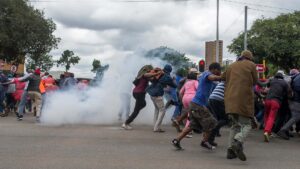





This past November was a truly dark period here in Nigeria.
- A Brigadier-General in the Nigerian Army and three of his men were abducted and killed by terrorists in Borno State
- 64 civilians were abducted in Zamfara State
- 25 female students and their principal were also abducted in Kebbi State
- 38 worshippers attacked in a church in Kwara State
- 15 people abducted, including four nursing mothers, in Sokoto State
- 52 students abducted from a Catholic school in Niger State and taken to an unknown location.
In fact, all of what I’ve mentioned above took place in just one week. One week. Five weeks before Christmas.
These are only some of the latest indications of the profound darkness enshrouding much Nigeria (as well as many other societies around the world). It is a darkness which has engulfed the world since Satan deceived our first parents, thousands of years ago (Genesis 3). And it has spawned not only pride, adultery, and unbelief, but also terrorism, corruption, and violence. We all are born and live within this corrupt realm, even if the darkness manifests differently across cultures (Romans 3:10).
Darkness at the First Christmas
The world of the first Christmas was no less dark. The chosen people of God had suffered humiliation at the hands of foreign powers for generations. The temple, that great symbol of God’s presence, had been destroyed by the Babylonians, though it was poorly rebuilt around 516 BC. The original glory and grandeur was no more. Various resistance movements had sought to liberate the land from foreign occupation, but all of them were crushed. Palestine was under Roman rule. This meant oppression, loss of freedom, and—worst of all—taxes.
The darkness wasn’t only political and economic. It also spiritual and religious.
But the darkness wasn’t only political and economic. It also spiritual and religious. God’s commands had been replaced with rafts of human principles. Ethical obligations, including regard for parents, could be jettisoned on pseudo-religious grounds (Mark 7:9-11). Religious sects held sway over people’s consciences. The Sabbath, God’s great enactment to give rest to his people, had also been deformed into a restrictive and oppressive system (Mark 2:27-28). God was hidden behind a web of religious rules.
However, at the right time, in the fullness of God’s providence (Galatians 4:4-5), the light came. “Unto you is born this day in the city of David a Saviour,” the angels announced. “He is Christ the Lord” (Luke 2:11). This was the light, shining in the darkness. The darkness couldn’t overcome it (John 1:5). The light came to make all of us children of God (see John 1:12). The light has come. It demands a response.
But how should we respond? Let me suggest three things, for those living in darkness.
1. Proclaim Light to Our Dark World
Light is needed because there isn’t only darkness all around us, but also inside of us.
The light must be displayed. We must offer Christ to the world.
As Paul wrote, “All have sinned and fall short of the glory of God” (Romans 3:23). Incarnation and redemption are God’s decisive action towards fallen, sinful humans. Jesus came that he might save us from our sins, from our own darkness (1 John 1:5-6). So the light must be displayed. We must offer Christ to the world. The gospel must be proclaimed, not just in Jerusalem or Nigeria, but to all nations (Matthew 28:19).
2. Live as Children of Light
The beauty of Christmas isn’t the gifts—though they’re great. It is in the awareness that God’s light has shone into our world and that we can now live by it. The true light is already shining (1 John 2:8). As Jesus exhorted us, we must follow him so we do not walk in darkness (John 8:12).
If we have embraced the light of the world, then we must live as children of light.
What does living in the light and as light imply? Once again, the angelic Christmas chorus informs us “He will save his people from their sins” (Matthew 1:21). The call then is to turn from our sins. “For the grace of God has appeared, bringing salvation for all people, training us to renounce ungodliness and worldly passions, and to live self-controlled, upright, and godly lives in the present age” (Titus 2:11-12). Christmas, therefore, is a time for believers to renounce ungodliness afresh; pursue purity as well as integrity; and be zealous for good works. If we have embraced the light of the world, then we must live as children of light.
3. Work for Light to Triumph Over Darkness
Earlier, I referred to the specific forms of darkness in societies, and considered the ongoing issues in Nigeria. As people who have embraced the light, we must expose the darkness around us, as best we can (Ephesians 5:11-12). This calls for boldness. And God has given us that grace through his Holy Spirit (2 Timothy 1:7).
We have a responsibility to pursue truth and justice.
In our various callings, we have a responsibility to pursue truth and justice, for it is Christ we serve (Colossians 3:23-24). Pray for wisdom and courage for our government to tackle the darkness of terrorism (1 Timothy 2:1-2). And as for the forces and powers who are opposed to Christ and his Church, we should join the psalmist to call on God to “speak to them in his wrath, and terrify them in his fury” (Psalm 2:5).
Hope for Those Sat in Darkness
The baby who was born on that first Christmas was to be known as Immanuel (Isaiah 7:14). In other words, God was present among his people, in an unprecedented way. As dark as the situation was, the light of God shone forth. Brightly. It was shining not just to save individuals through a Redeemer, but to transform society by establishing God’s kingdom on earth. This was reassuring, both then and now.
Jesus remains the light to lead us out of today’s darkness.
As we reflect on Christmas, we recall that this Jesus is the same for all time (Hebrews 13:8). He remains the light to lead us out of today’s darkness. And I hope my country pays attention.
 DON’T HAVE PAYPAL TO SET UP A MONTHLY DONATION? If you would like to donate via Payfast – a secure payment gateway available to donors both inside and outside of Africa – please click here.