






I cried when Timothy died. But who was Timothy?
An engaging story of faith lived out amidst drug addicts.
You’ll know when you read Jonathan Tepper’s Shooting Up. It’s a remarkable memoir of Tepper’s years growing up as the son of missionary parents and founders of Betel, an international organisation providing rehabilitation for people struggling with drug and alcohol addiction. This was an engaging story of faith under Christian missionary parents and lived out amidst the reality of ministry day-in-day-out among drug addicts. Tepper’s father was the spiritual head and director of their home, discipling his children both at family prayer times and daily meals. In Tepper’s words, he was “the autocrat of the breakfast table, the inspiration for learning, the oracle of good taste, and the arbiter of ideas” (p126). Alongside him stood mum, the companion who steadied his bold visions, “the Sancho Paza to his quixotic dreams, the one who kept the show on the road” (p8).
A Childhood to Remember
Shooting Up provides a fascinating and profound look into the author’s childhood. His account of growing up as one of four boys brought to mind my own childhood, being the youngest of four brothers. As an African whose childhood was in the northern Nigerian city of Kano, Tepper’s context was obviously very different from mine. Unlike him, I didn’t have the privilege of an early grounding in the Bible or a family committed to the gospel. However, I’m grateful that I have memories of loving parents and the companionship of three older brothers. Aside from the stark and dismal reality of San Blas in Spain where he grew up, Tepper introduces us to the several characters and remarkable individuals who make up that story.
Tepper’s book is a story about grappling with the experiences of growing up as a reflective teenager in a Christian household. And he contemplates the Christian faith itself at several points along the way. This isn’t unexpected for a teenager, and it indicates the openness with which Tepper reveals his own inner development.
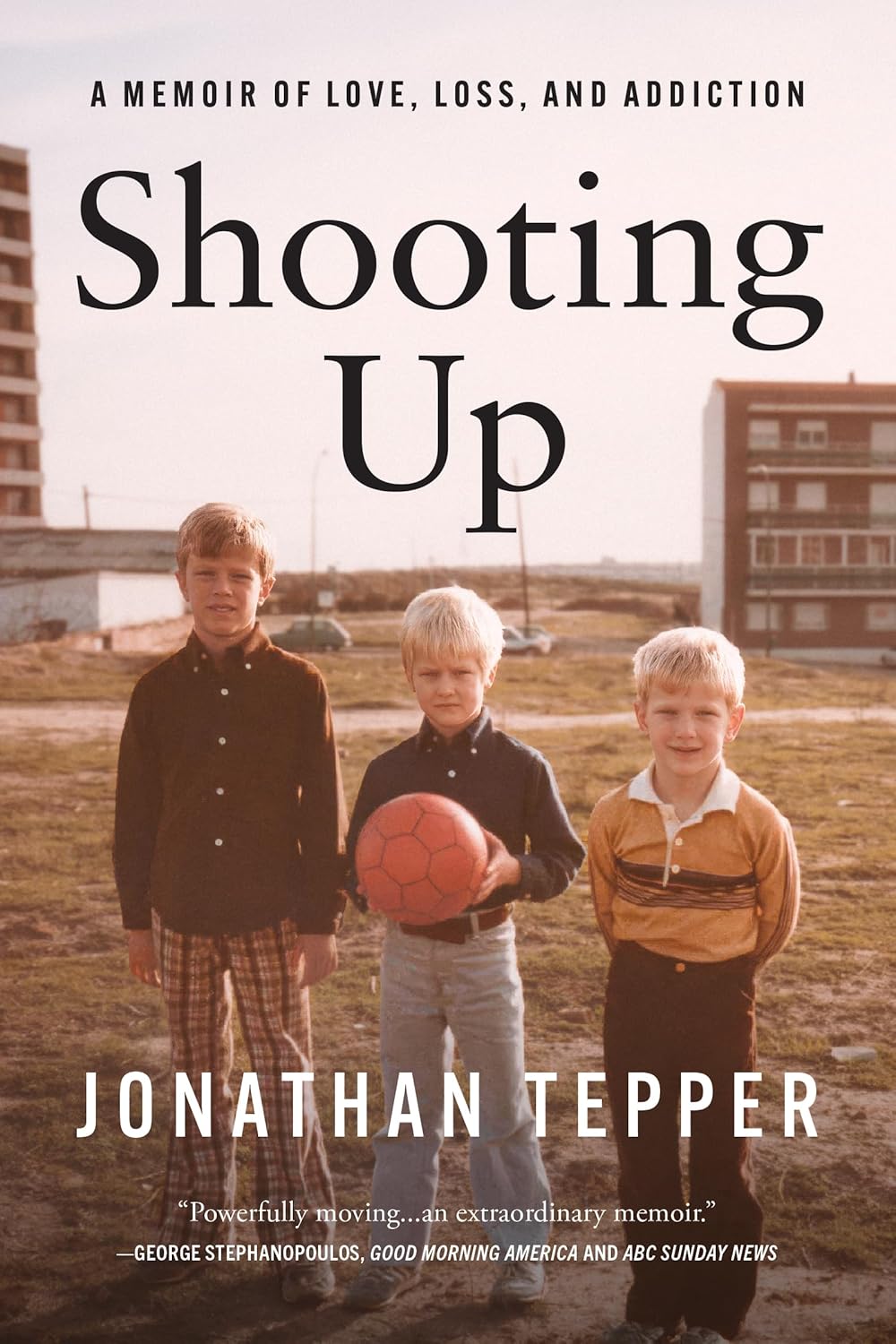
Shooting Up: A Memoir of Love, Loss, and Addiction
Jonathan Tepper
This is a memoir about choosing to see beauty in ruins, finding family among outcasts, and learning that the answer to suffering is always more love. It is a story of love and loss, but it is also a love letter to friends, family, and even learning. Part Angela’s Ashes, part Cross and the Switchblade, Shooting Up announces Tepper as a powerful new voice in memoir, one who transforms a harrowing childhood into an unforgettable testament to hope.
Tepper grapples with the experiences of growing up as a reflective teenager.
As a memoir, Shooting Up examines not only the supposed innocence of childhood but also the excitement of growing up in a rapidly changing world. He experiences the onset of HIV as a global epidemic, with San Blas itself serving as a major point of focus. He also journeyed through childhood with books, from authors as diverse as J. R. R. Tolkien and Dante Alighieri, many of whom would prove significant in his later years. Tepper was also exposed to the world of music growing up, with composers as diverse as J. S. Bach and Joan Baez.
Reading Jonathan Tepper’s story in Shooting Up brought three significant themes to mind.
1. Behold What Grace Can Do
In countless ways this book is a commentary on the wonder of God’s redeeming grace. While the term ‘grass to grace’ might be a little cliche, it was nevertheless the reality of San Blas and the beginnings of Elliott Tepper’s ministry, which would later evolve into Betel Mission. Of course, we’re familiar with God changing Paul from a fanatical Pharisee into a passionate evangelist for Jesus (Acts 9). But God didn’t stop with Paul. He has replicated that same pattern for over 2 000 years and Shooting Up highlights some glorious examples of that redeeming grace.
Shooting Up highlights glorious examples of redeeming grace.
We see Raúl, the addict-turned leader who becomes a pillar in the developing ministry. Here was a heroin addict who’d turned robber and lived several months on the streets. But when God would have him, there a spectacular change occurred. Tepper writes this about Raúl, “One night, he sat alone in the living room in the dark and prayed, ‘Whatever love and kindness you’ve given Lindsay, give that to me. Come into my heart, forgive me of my sins. Give me love for others'” (p35).
Raúl became invaluable to the mission. Aside from getting married and becoming a loving father, Raúl became a teacher and father to so many ex-addicts like himself.
The author also recounts the working of God’s grace in Miguel Jambrina, popularly known as Jambri. For several years, Jambri coordinated their used furniture shop or rastro. As a teenager, Jambri had got involved with a gang of bank robbers and eventually served jail time. He was on hard drugs, abusing alcohol and had been a heavy smoker since the age of 13. But God set him free and made him Jambri an instrument of transformation for others on the same destructive path.
2. Suffering and God’s Purposes
Shooting Up is also an account of how suffering and tragedy can work to shape our lives. Between the death of his younger brother, Timothy, and the eventual suicide of his mother in 2012, there was a long list of lost friends, including Raúl and Jambri. Painful as these losses were, God was forming Tepper through them. He would still discern God’s goodness in the gifts of a loving family and community. In his words, “death has made me aware of the preciousness of life, the importance of family and friends, and the overwhelming power of love and memory” (p266). And that is also the case for us as individual believers today.
Suffering and tragedy can work to shape our lives.
What indescribable blessing has resulted from the gruesome death of Jesus on the cross. Imagine the outflow of compassion which the sufferings of the Christian community has birthed over the centuries—hospitals, homes for those with disabilities, orphanages, as well as several policies and systems centred on caring for others. It reinforces Jesus’ pronouncement that unless a grain of wheat falls to the earth, it abides alone. But when it dies, it yields much fruit (John 12:24).
3. Attempt Little, Great Things for God
Why would a graduate of both Harvard and Cambridge end up in a place like San Blas, Madrid? How could he abandon his former thoughts of ministry among college students and instead work with drug addicts, with yonkis? Shooting Up partially answers these questions, reminding us to go wherever God leads, however undignified it might seem.
Go wherever God leads.
Here we might recall the words of the famous pioneer missionary to India, William Carey: “Expect great things from God; attempt great things for God.” This was the watchword of a man with far less formal education than Elliot Tepper. Carey was a poor but determined cobbler, who would go on to shape a nation and transform the modern world. Imagine what could happen if the Alius, Kwames, and Oluseguns of today answered God’s call to courageously trust and obey. I believe we would see an Africa where the gospel isn’t merely preached but actively reshaping every sphere of life.
A Story to Shape Others’
Tepper’s story throughout Shooting Up is a vivid picture of a childhood shaped by the Christian faith. Among other things, it reinforces the truth of Proverbs 22:6, “Train up a child in the way he should go; even when he is old he will not depart from it.” Having a godly family isn’t trivial; it is crucial to who we become and how we end up seeing ourselves. So, aside from being merely a memoir of one child’s upbringing, Shooting Up is a call to build godly homes where Christ is loved; his word honoured; and lives of faith nurtured.
 DON’T HAVE PAYPAL TO SET UP A MONTHLY DONATION? If you would like to donate via Payfast – a secure payment gateway available to donors both inside and outside of Africa – please click here.