



Who has the greatest influence over the future of the world? Ask that question today and you’ll hear a range of answers. Some will point to presidents and prime ministers. Others to billionaires, artificial intelligence, financial markets, or military power. Every generation has its own candidates for who really controls history.
Before God explains history, he reveals himself seated on a throne.
The first Christians had their own answer. It was Caesar! It was Rome. Rome’s armies were unmatched. Its emperor was worshipped as “lord.” Its power seemed unshakeable. Christians were a small, vulnerable minority living under the shadow of an empire that claimed ultimate allegiance. If there was ever a moment to wonder who was really in control, this was it.
Many Christians approach Revelation asking the same kind of question. They want to know what the beasts represent; who the antichrist is; or how current events fit into biblical prophecy. But before Revelation addresses any of those questions, it does something unexpected.
John isn’t first shown a beast of Babylon. He isn’t shown judgement. Before all of those, God shows him a throne. Before God explains history, he reveals himself seated on a throne. That isn’t an incidental detail. It is the key to reading the entire book of Revelation
Reading Revelation the Wrong Way
Revelation is probably the most misunderstood book in the Bible. For many Christians, it has become a puzzle to solve rather than a vision to inhabit. We search for clues that unlock the future while overlooking the Christ whom the vision reveals. Yet Revelation wasn’t written to satisfy our curiosity. It was written to strengthen our faithfulness.
Revelation is probably the most misunderstood book in the Bible.
John tells us from the outset that this book is “the revelation of Jesus Christ” (Revelation 1:1). Not merely a revelation from Jesus, but a revelation of Jesus. The hero of the book isn’t the beast or Babylon. It is the risen and reigning Christ. Perhaps, then, we’re asking the wrong questions.
Instead of asking, “What does 666 mean? Who are the 144 000? What is the millennium?” perhaps we should first ask, “What truth about Jesus am I failing to see?” Revelation is less concerned with helping us decode tomorrow than helping us see today from heaven’s perspective.
A Door Into Reality
In Revelation 4, John sees “a door standing open in heaven” (Revelation 4:1). He is invited to step through and view reality from God’s perspective. Notice what he doesn’t see first.
John’s vision is making a theological statement as well as a prophetic one.
He doesn’t see Rome. Nor the persecution of believers in Asia Minor. He doesn’t see persecution. No. John’s attention is immediately drawn elsewhere. “Behold, a throne stood in heaven, with one seated on the throne” (Revelation 4:2). The throne dominates this chapter of Revelation. Everything else revolves around it. The dazzling jewels, the flashes of lightning, the sea of glass, the living creatures, the elders—all exist to direct our attention to he who sits at the centre.
John’s vision is making a theological statement as well as a prophetic one. History has a centre. And it is occupied by a person.
Heaven Isn’t Panicking
There is something strikingly calm about Revelation 4.
Let’s not forget that John is in exile. Earth feels chaotic. The churches are under pressure. The Roman Empire seems unstoppable. Yet heaven is untroubled. God isn’t pacing. He isn’t consulting advisers about how to react to unfolding events. He is seated. And that posture really matters.
Sitting on a throne is the posture of sovereign rule.
Throughout scripture, sitting on a throne is the posture of sovereign rule. Only God’s seated position isn’t one of inactivity but complete authority. Nothing has caught heaven by surprise. Nothing threatens God’s reign.
The same remains true today. Wars erupt. Governments change. Economies collapse. Churches experience opposition. Our own lives can be marked by grief, uncertainty, illness, or unanswered questions and prayers. Yet Revelation reminds us that none of these events mean the throne has been vacated. Before the beasts, there is a throne. Before today’s headlines and tomorrow’s uncertainties, there is a throne. Our God occupies it.
Heavenly Worship Reveals Who’s Ultimate
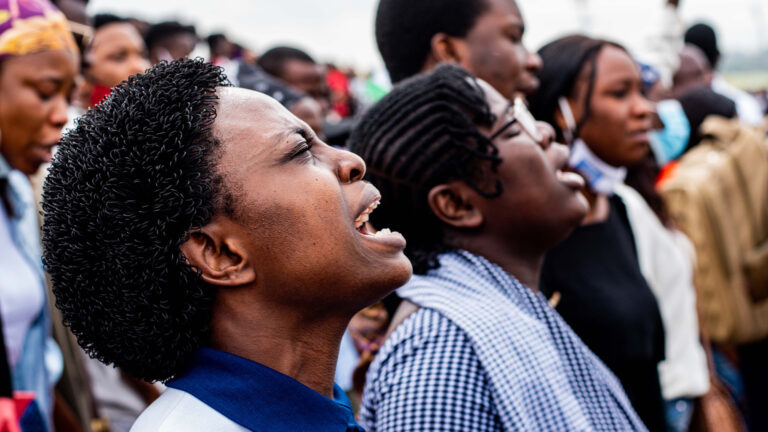
One of the remarkable features of John’s vision is that everyone knows where to look. The four living creatures never cease declaring God’s holiness. The 24 elders repeatedly fall before him. Their worship isn’t casual. Nor is it restrained. They cast their crowns before the throne, declaring, “You are worthy, our Lord and God, to receive glory and honour and power, for you created all things” (Revelation 4:11).
And these actions are profoundly significant. A crown represents authority, achievement, and honour. Yet these elders gladly surrender theirs because every authority ultimately belongs to God. In the Roman world, such worship carried political implications. Caesar claimed supreme allegiance. John’s vision insists otherwise. True worship is more than an emotional experience. It is an act of allegiance. Every time God’s people gather to worship, they declare that no government, ideology, economy, or ruler deserves the place that belongs to God alone.
In a world filled with competing loyalties, worship becomes an act of resistance—an act of refocusing or fixing our eyes again on the true spectacle, power. So, while there’s cosmic and environmental collapse (Revelation 6:12-14) and elite and noble hide in caves with people begging that mountains fall on them (Revelation 6:15-16), the throne alone is permanent.
The Vision We Truly Need
We often ask God for explanations. Why this diagnosis or that delay? Why this injustice or this suffering? Sometimes God answers. Often he does something better. He reveals himself.
This is the pattern throughout scripture. Job receives a vision of God’s greatness before he receives explanations. Isaiah encounters God’s holiness before receiving his commission. Habakkuk learns to trust God’s sovereignty before history unfolds. Revelation follows the same pattern.
Before the beasts, there is a throne.
Before God explains history, he reveals his throne. Perhaps that is exactly the vision the church needs today. We live in anxious times. News cycles move faster than ever. Political uncertainty, economic instability, technological change, and cultural hostility can leave Christians feeling overwhelmed. Revelation doesn’t call on us to deny those realities. It invites us to see them from another vantage point, through an open door and into heaven’s throne room, where the throne is still occupied. Where worship still rises and our God reigns. Where the future of the world has never been in safer hands.
So before you try to identify the beasts, look to the throne. Because before the beasts, there is a throne.