



In my few years of full-time ministry, through interactions with fellow gospel workers as well as Christian brothers and sisters from different parts of our continent, I’ve observed that many African Christians struggle with assurance. I don’t mean assurance about whether or not God exists; or whether Christianity is true; but assurance about salvation. Believers struggle to believe they’re truly saved and fully forgiven. They doubt they’re genuinely adopted into God’s family.
Many Christians live as though they are on spiritual probation.
Many genuinely believe the gospel. Yet at the same time, many quietly wonder whether God’s patience is running out. These people don’t dispute that Christ died for sinners. However, they sometimes question whether their own sins are simply too persistent, too repetitive, or too serious. They insist that salvation is by grace. Only they simultaneously often live as though God’s acceptance must be earned. We rarely announce this struggle publicly. Rather, it surfaces in more subtle ways:
- doubting salvation after sinning
- serving tirelessly out of fear
- avoiding prayer because of shame and spiritual failure
- thinking every hardship and setback is evidence of God’s displeasure.
In many cases, Christians live as though they are on spiritual probation. ‘Yes,’ we think. ‘I have a place in God’s family.’ But, we wonder, ‘is it secure?’ When we think this way, we believe that staying in God’s family depends on consistency, obedience, devotion, and spiritual maturity. This thinking breeds a destructive cycle that ends in despair. It’s a cycle from striving to failure, guilt and renewed effort before spiritual exhaustion and defeat. Assurance is fragile, tethered to personal performance rather than being anchored in Christ (Hebrews 6:19).
A Perennial Problem for Christians
Thankfully, this crisis of assurance isn’t uniquely modern. It isn’t new. For centuries, Christians have wrestled with this same fundamental question. How can sinners who continue to struggle with sin possess genuine confidence that they are fully forgiven, truly justified, and eternally accepted by God?
The key to enduring assurance is neither flawless obedience nor heightened spiritual experience.
It is this deeply pastoral question that Sherif Fahim addresses in Justification, Sanctification, and Union with Christ. Through a careful historical study, Fahim argues that we can experience deep, unshakable, lasting assurance, even when acutely aware of our ongoing sinfulness, only through a proper grasp of union with Christ, the doctrine that unites justification and sanctification. This is Fahim’s central claim: the key to enduring assurance is neither flawless obedience nor heightened spiritual experience, but a right understanding of our union with Christ, from which both justification and sanctification flow.
While many scholars have examined these doctrines in isolation, Fahim demonstrates that the antidote to our anxious, performance-driven insecurity is a robust recovery of the Reformation doctrine of union with Christ.
The Flow of Fahim’s Book
Fahim’s central thesis is straightforward. Justification and sanctification are distinct blessings of salvation. However, they’re never separate. For both flow from the believer’s union with Christ (p35-36). Fahim serves as a historical guide, retrieving comforting truths forged in the fires of early church controversies. He shows that the Reformers structurally secured our assurance, building it on an unshakeable foundation rather than our shifting emotions. He traces this life-giving truth through three distinct movements.
a. Calvin: Union with Christ and the Duplex Gratia
First, Fahim explores John Calvin’s doctrine of duplex gratia (or “double grace”). According to Calvin, when believers are united to Christ by faith, they receive two inseparable benefits: justification and sanctification. Justification concerns our acceptance before God through Christ’s righteousness; sanctification concerns our transformation into Christ’s likeness. Though distinct, they are united because both are found in Christ himself. Drawing on Partee’s work on John Calvin, Fahim calls justification a complete fact that God accomplished for us, whereas sanctification is the ongoing work God accomplishes with us.
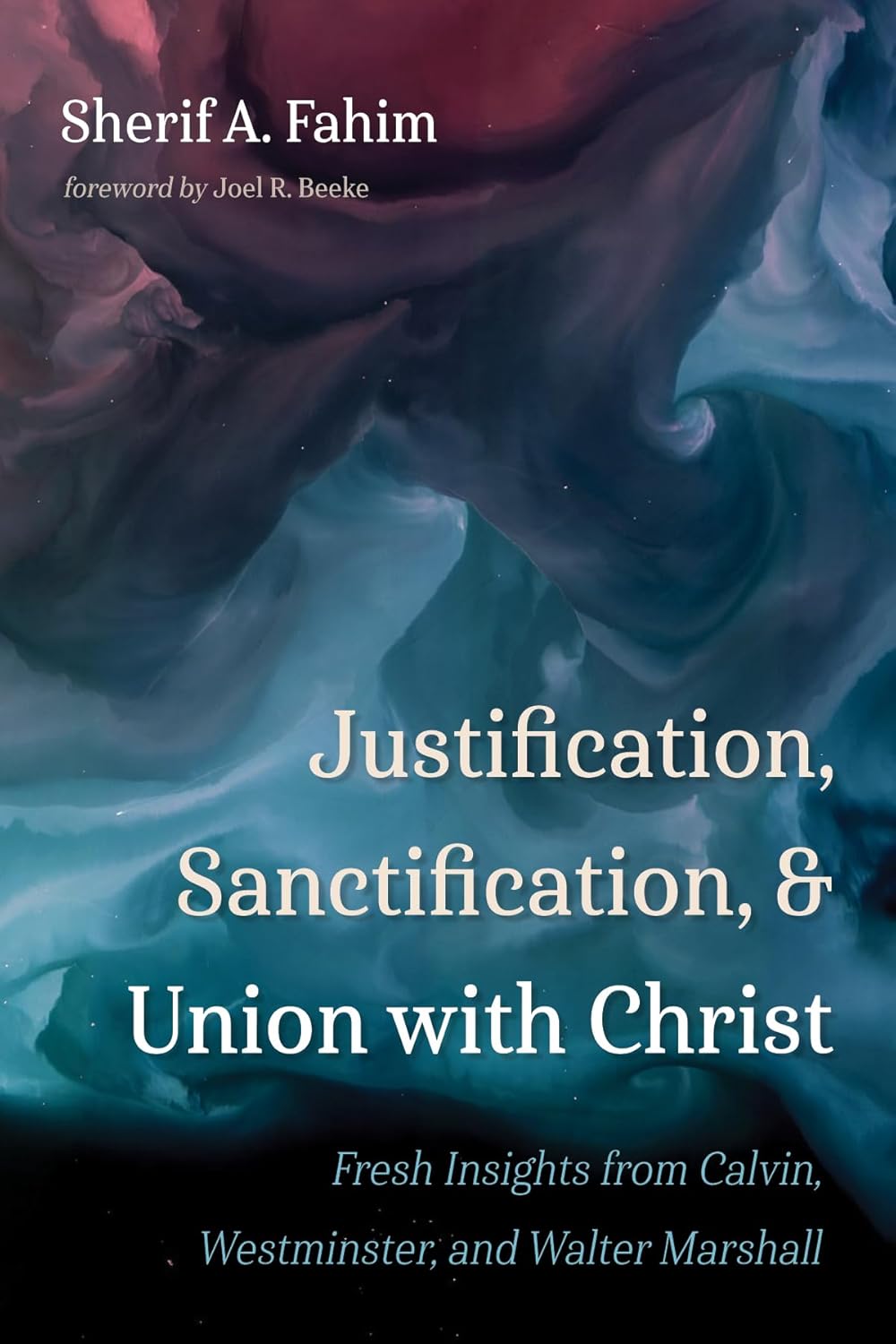
Justification, Sanctification, and Union with Christ: Fresh Insights from Calvin, Westminster, and Walter Marshall
Sherif A. Fahim
Justification, Sanctification, and Union with Christ: Fresh Insights from Calvin, Westminster, and Walter Marshall
Sherif A. Fahim
The opposition against legalism and antinomianism is a fight that Calvin, the Westminster Divines, and Walter Marshall were involved in. Both errors are strongly connected, and we are prone to swing between them because they lead to each other. When we think that being forgiven in Christ means that we aren’t bound to the law, we can fall into antinomianism. As a reaction, we might go to the other extreme, legalism, when we treat obedience as the condition for our salvation. The final result is despair, which leads to hatred of the law and subsequently of God. Only the gospel breaks this pattern.
Our ongoing struggles with sin don’t invalidate our legal standing before God.
John Calvin’s insights are a pastoral balm for the anxious soul. He famously argued that these two benefits are joined by an “indissoluble tie.” Separating them, he went on, is to “tear Christ in pieces” (Institutes 3.16.1). Both these graces flow from the same union with Christ. Therefore, our ongoing struggle with sin (sanctification) doesn’t invalidate our legal standing before God (justification). If we have Christ, we possess his perfect righteousness as our secure standing before God, even as his Spirit gradually conforms us to his likeness.
b. The Westminster Standards: Safeguarding Assurance Through Union
Your bad days cannot rewrite God’s legal verdict.
Fahim then turns to the 17th-century Westminster Assembly, showing how the “divines”—the eminent theologians and pastors appointed to chart the Church’s doctrinal course—maintained this delicate balance amid intense theological turmoil (p22-23). The Westminster Standards define union with Christ as the communion in grace, from which all other benefits flow. By serving as the organic bridge that keeps justification and sanctification distinct yet inseparable, the Westminster Standards protect the objective anchor of our assurance (p36). Justification is a forensic (judicial) declaration based on Christ’s obedience, not our internal goodness, meaning your bad days cannot rewrite God’s legal verdict.
c. Walter Marshall: The Outworking of Union With Christ
The book’s final and most substantial section focuses on the 17th-century Puritan Walter Marshall and his seminal work, The Gospel Mystery of Sanctification. Over three chapters, Fahim argues that Marshall offers one of the clearest pastoral applications of the Reformed doctrine of union with Christ.
Assurance of God’s love is the only power that can make a person holy.
Fahim beautifully situates Marshall’s theology within his intense personal spiritual struggle, a period of “profound spiritual darkness.” In that period, Marshall sought holiness and peace through rigorous self-effort, fasting, and mortifying sin; that was, until he realised that the power for godliness lies entirely in Christ. Marshall’s breakthrough came when he realised he had the gospel backwards. He was trying to become holy to gain assurance, rather than recognising that assurance of God’s love is the only power that can make a person holy.
d. Conclusions
Taken together, these three historical voices constitute the progression of Fahim’s argument. Calvin lays the theological foundation by locating both justification and sanctification in the believer’s union with Christ. The Westminster divines preserve this framework in their confessional theology, carefully maintaining the distinction between these two blessings while showing that they can never be separated. Marshall then demonstrates the practical implications of this doctrine, arguing that assurance is not the reward for becoming holy but the very means by which believers grow in holiness.
Both our acceptance before God and transformation into his likeness are secured in Christ.
The argument culminates in a simple yet profound conclusion: the anxious Christian finds lasting assurance not by looking inward at the quality of personal holiness but by looking outward to Christ. For it is in Christ that both our acceptance before God and transformation into his likeness are secured. Union with Christ, therefore, is the theological key that unites justification and sanctification. Union with Christ enables believers to pursue holiness from the security of God’s grace, rather than in the hope of earning it.
A Critical Work for the Contemporary Church
The theological vision that Fahim retrieves has obvious significance for contemporary Christians wrestling with assurance and holiness. Many believers today fight sin while secretly wondering whether God still accepts them. They examine their spiritual fruit; measure their progress; and scrutinise every failure. Each setback quietly becomes fresh evidence against their own salvation. The result is a faith driven by performance rather than peace.
The power for holy living comes from resting in Christ.
Marshall’s central insistence runs counter to this pattern: assurance must precede sanctification; not follow from it. This is no minor adjustment. It is a powerful reordering of the entire logic of the Christian life. A guilty conscience naturally treats God as a judge to be appeased. Such a person may conform outwardly, but genuine love and joyful obedience are impossible where fear and self-doubt reign. Only when sinners are genuinely persuaded that they are fully reconciled to God through Christ can true holiness begin to take root and flourish.
Thus, Fahim’s retrieval of Marshall is more than a contribution to historical theology. It is a much-needed pastoral corrective. The power for holy living doesn’t come from relentless self-examination. It comes from resting in Christ and drawing life from union with him.
This theological vision is compelling. But a question lingers over the book as a whole: does it do enough to help modern readers apply what Marshall taught? It is one thing to retrieve a tradition with historical and theological care. But it’s another to hand it to a struggling Christian or a busy pastor in a usable form. It is with this question in mind that we now examine what the book achieves and where it falls short.
Three Strengths of Fahim’s Book
i. Historical Theology in Service of the Church
One of the book’s greatest strengths is its demonstration that historical theology serves the church. Fahim doesn’t treat Calvin, Westminster, and Marshall as museum pieces. Instead, he shows that these theological debates emerged from real pastoral concerns. Questions about assurance, holiness, and the Christian life aren’t only modern problems. They’ve occupied faithful Christians for centuries.
ii. Retrieving Union With Christ as a Central Category
Another strength is Fahim’s careful retrieval of union with Christ as a central theological category. Contemporary discussions sometimes isolate justification and sanctification from one another, leading either toward legalism or antinomianism. Fahim demonstrates that the Reformed tradition consistently understood that both blessings flowed from the believer’s participation in Christ. This recovery brings coherence and depth to discussions around soteriology.
iii. A Corrective to Performance-Based Christianity
Fahim’s book also provides a compelling challenge to performance-based Christianity. Many believers functionally measure God’s acceptance by their spiritual consistency, ministry involvement, or moral success. Fahim’s study reminds readers that the foundation of assurance isn’t found within the believer but outside of them, in the finished work of Christ.
Many believers functionally measure God’s acceptance by their spiritual consistency.
This emphasis is especially valuable in a cultural moment where identity is often built upon achievement and performance. What makes it urgent is that this performance culture has not remained outside the Church, but has taken root within it, quietly reshaping how believers think about God’s acceptance or love and grace. Fahim reminds us that the gospel offers something radically different: acceptance before achievement.
Areas Where Readers May Desire More
I could add many points to the three above, but the book isn’t without its limitations. Before getting to those, I must add: these critiques don’t deny or undermine the book’s contribution. Rather, they reveal opportunities for further application and reflection, inviting other scholars and practitioners to carry this retrieval project forward.
i. The Density of Academic Discussion
The book’s academic nature occasionally creates a barrier for non-specialist readers. Fahim carefully navigates historical debates and theological distinctions, but the density of some discussions may prove challenging for ordinary church members without theological training. Those who would benefit most from Marshall’s pastoral insights may find themselves unable to access them without significant effort.
ii. The Emotional Dimensions of Assurance
Fahim’s discussion of assurance remains largely theological and historical. While this focus is understandable, many contemporary struggles with assurance involve far more than doctrinal confusion; they are bound up with psychological wounds, trauma, anxiety, depression, and deep experiences of shame. Readers wrestling with these realities may wish for greater engagement with the emotional and experiential dimensions of assurance, not only its theological foundations.
iii. Bridging The Gap Between Theology and Discipleship
While Fahim succeeds in demonstrating the historical relationship between justification and sanctification, he offers relatively little guidance for translating these insights into contemporary discipleship contexts. Readers are often left to build the bridge between 17th-century theology and 21st-century ministry by themselves.
Why African Believers Should Read This
Fahim’s work has particular relevance for many African church contexts.
Across the continent, believers often face the temptation to interpret suffering, sickness, financial hardship, or personal struggles as evidence of divine displeasure. Even within gospel-preaching churches, Christians can subtly begin to evaluate their standing before God through the lens of performance, spiritual achievement, or visible blessing. Against these tendencies, Fahim offers an impactful biblical reminder: our standing before God rests not upon our achievements but upon our union with Christ.
This truth is especially important for believers who struggle with recurring sin.
This truth is especially important for believers who struggle with recurring sin and ongoing weakness. Many Christians assume that their failures somehow disqualify them from God’s love. Fahim reminds us that justification and sanctification flow from the same Christ. The believer’s ongoing battle with sin does not nullify God’s declaration of righteousness. Nor does God’s declaration remove the necessity of growth in holiness. Both blessings are found in Christ himself.
Our Theological Riches Put to Work
Ultimately, Justification, Sanctification, and Union with Christ is far more than a work of historical theology. It’s a reminder that the deepest resources for pastoral ministry are often found in the church’s theological inheritance. Fahim’s central message is both simple and profound: believers grow in holiness not by looking more intensely at themselves but by looking more steadily to Christ.
The deepest resources for pastoral ministry are often found in the church’s theological inheritance.
For pastors, seminarians, and thoughtful church members, this book provides a rich retrieval of a doctrine that stands at the heart of the Christian life. For believers who struggle with assurance, who feel trapped in recurring sin, or who wonder whether God’s acceptance fluctuates with their performance, it offers something even more valuable. It directs their gaze away from themselves and toward Christ, who is both their righteousness and their holiness. And that is precisely where assurance has always been found.