In this book Jamie Viands has carefully, clearly and systematically presented a biblical theology of priesthood to shed much needed, illuminating light on a growing concern in African Christianity: the elevation of pastors and other church leaders into a special spiritual class through whom ordinary Christians are made to believe they must approach God for his blessing, protection and healing.
Have we placed our confidence in a human leader when the Bible calls us to trust Christ alone?
This phenomenon is a serious abuse of church leadership, argues Viands, because it is a serious distortion of the gospel, displacing the unique mediatorial ministry of Jesus Christ as well as diminishing the priestly privileges and responsibilities of ordinary believers. Thus I believe that this book is essential reading for the African church, from pastors to leaders, theological students and those sitting in the pews. The book’s most uncomfortable question may not be, “Which pastors have become men of God?” but rather, “Have I, as a Christian, placed my confidence in a human spiritual leader when the Bible calls me to trust Christ alone?”
That question makes this book both deeply personal and profoundly ecclesial. Viands calls our attention to both the distressing departures from the gospel and the problematic leadership structures in the African church today, which have led many concerned observers —seeing the rapid numerical growth of the Church on this continent— describe the African church as being “a mile long and an inch deep.”
A Brief Outline of the Book
Viands’ book comprises seven chapters. In the first chapter he examines the failed mediators in the priesthood culture of the Old Testament and in the second he explains the successful mediation of Christ’s priesthood in the New Testament. Through chapters three to five Viands explains the origins of the man of God syndrome and examines how it undermines the priesthood of Christ as well as the new covenant priesthood of all Christians. Viands also describes the gospel-focused and Christ-centered role of a pastor, as defined by the New Testament. In chapters six and seven Viands reviews the New Testament role of the pastor, explaining why we must confront the man of God syndrome.
Particularly worthy of note are chapters three and four, where Viands presents the major ways in which the man of God can usurp the mediatorial work that uniquely belongs to Christ. These include making offerings acceptable to God; communicating God’s revelation; mediating answers to prayer; and conveying God’s blessing.
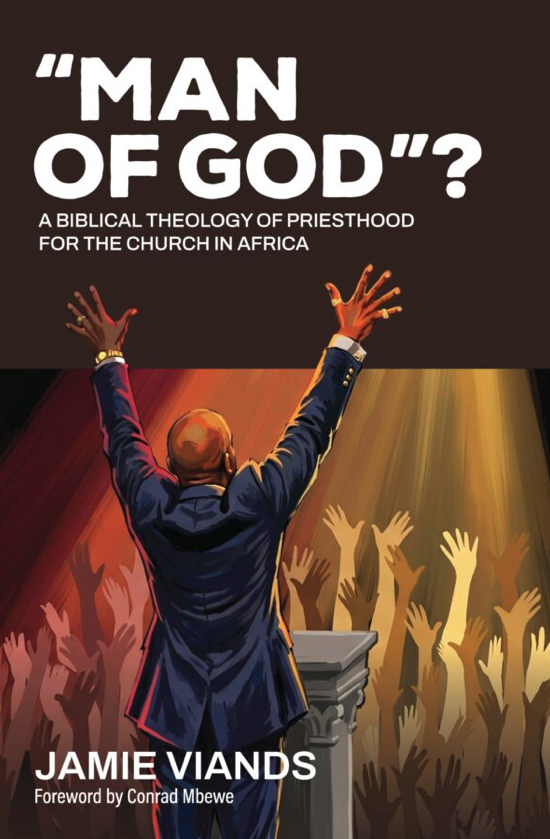
"Man of God"? A Biblical Theology of Priesthood for the Church in Africa
Jamie Viands
"Man of God"? A Biblical Theology of Priesthood for the Church in Africa
Jamie Viands
Jamie Viands’s book is a crucial book for a time such as this. In it he carefully, clearly and systematically presents a biblical theology of priesthood to explain why and how the elevation and veneration of church leaders in the African church today as ‘men of God’ is a serious violation of God’s word, undermines the gospel, and replaces Christ Jesus himself as the cornerstone and focal point of our faith.
The man of God doesn’t merely take from Christ, he also strips ordinary Christians of their privileges in Christ.
But Viands explains that the man of God doesn’t merely take what belongs to Christ; he also strips ordinary Christians of their privileges and responsibilities in Christ. These include offering spiritual sacrifices, understanding and applying scripture, discerning truth from error, interceding for others, and blessing others (1 John 2:20, 27; Colossians 3:16; 1 Corinthians 14:26; Galatians 6:1-4; Ephesians 4:15-16, 25, 32; 2 Corinthians 2:5-11).
The Unique Strengths of Viands’ Work
Confronting the Man of God Syndrome
In my view the greatest strength of Viands’ book is his urgent call to confront the man of God syndrome, while offering helpful guidelines for effectively doing this. These guidelines include encouraging African pastors to point people away from themselves and toward Christ; encouraging Christians to study scripture for themselves; the cultivation of humility and vulnerability among church leaders; and the removal of religious practices that imply any spiritual superiority of church leaders. Viands goes on to recommend a plurality of elders in our churches as a means of fostering accountability and resisting the elevation of one individual to the top of a spiritual hierarchy.
African Traditional Religion
Viands explains that the primary factor enabling these so-called men of God to become entrenched in African Christianity is the lingering impact of traditional African religious beliefs and practices in African churches. These traditional African worldviews have led to an overemphasis on “blessed objects”, offerings, and powerful leaders. Because African Christianity is largely still in transition from ATR to the gospel, the man of God syndrome has easily slipped in through these ATR-created cracks and taken centre-stage.
The Priesthood of all Believers
Throughout this book Viands aims to recover the priesthood of all believers in African churches (1 Peter 2:9; Revelation 1:6). He explains that this isn’t a declaration that pastors are unnecessary. Rather, he calls our attention to the need for a biblical balance in which pastors take their rightful place as shepherds and teachers, while recognising and humbly accepting that they too are sheep in Christ’s flock with God-given spiritual gifts and authority, which can only be faithfully exercised under Christ’s authority.
Pastoral responsibility is for equipping believers for ministry rather than for monopolising leadership for personal power and financial gain. For the African church today, this is both a healthy and critical corrective to both authoritarian church leadership and passive congregationalism.
The Supremacy of Christ
Viands insists that confronting the man of God phenomenon is about much more than criticising greedy and misguided African pastors and prosperity preachers. Confronting this syndrome, he urges, aims at calling the African church to recover the sufficiency and supremacy of Jesus Christ.
It isn’t only that pastors receive too much honour; it’s that Christ receives too little.
Viands’ concern, then, isn’t only that pastors receive far too much honour. It is that Christ receives too little, while ordinary Christians are robbed of their identity in Christ, their ecclesial responsibility, and the gift of their direct access to God through Christ. Viands would have us remember that Christ alone is the believer’s mediator. Christ alone must occupy the centre stage of our hearts and the church.
Prophets for Profit
Finally Viands reminds us that in many African churches today these men of God go by other titles—such as apostle, prophet or shepherd—and for a handsome offering or tithe these men claim to be able to mediate God’s answer to prayer, healing, and diverse forms of material prosperity. In this way their spurious titles enable them to profit from their suspect prophecies.
A Book for Africa, Today
In the interest of growing healthy, gospel-focused and Christ-centered churches in Africa, we all need to bring teachable and humble spirits to this book, asking the Lord to show us how we may have deliberately, or inadvertently, fostered the heretical veneration of church leaders so that we may repent and return to placing Christ and his gospel alone at the centre of our witness and ecclesiology.
We all need to bring teachable and humble spirits to this book.
We all need to do this for the sake of our own spiritual growth and maturity, for the sake of the spread of the gospel in Africa, for the sake of the numerous spiritually lost men and women around us, and for the sake of the glory of God. In short, Viands’ book is a desperately important one for a time such as ours.