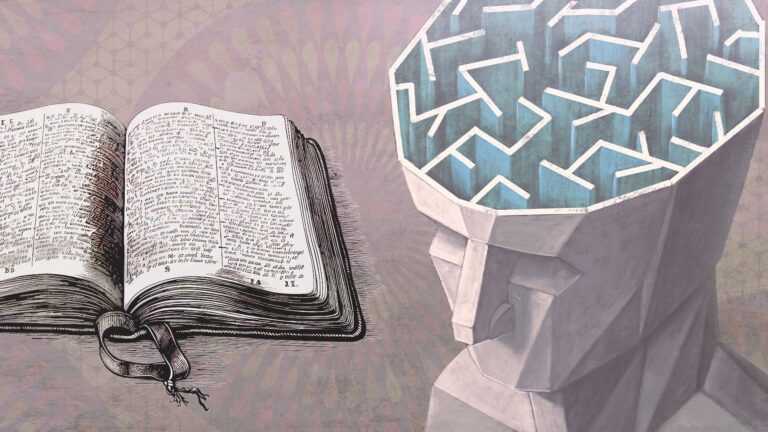






The difference between a Bible that is God’s word and one that only contains God’s words changes everything about how we read it. That difference will profoundly shape how we read it, what we expect. Do we hear God when the Bible is read or must we listen for God’s voice in the Bible?
Do we hear God when the Bible is read or must we listen for God’s voice?
More than once, a friend or relative has come to me convinced that our Bibles are corrupted; that the Church removed certain books long ago; and that to find the whole truth we must read what was taken out. They insist that the Bible only contains the word of God, while it isn’t God’s word in its entirety. But is that true? So much depends on how we answer that question.
Paul understood this uncertainty. This unease. “All Scripture is breathed out by God,” he wrote, “profitable for teaching, for reproof, for correction, and for training in righteousness, that the man of God may be complete, equipped for every good work” (2 Timothy 3:16-17). These words were addressed to a people forever learning but never arriving at the truth, something encouraged by imposters in the local church who were opposed to God’s truth (2 Timothy 3:6-8).
Not Some Parts But All of It
Notice Paul’s initial insistence. He says “all scripture.” Not the agreeable parts nor only the verses we’d underline if the choice were left to us. He says the whole counsel of God. Therefore, if we desire to hear from God we don’t need to hunt for his words but simply open our Bibles.
If we desire to hear from God we don’t need to hunt for his words,
Alternatively, if we believe that the Bible merely contains God’s words we cannot share Paul’s conviction. Instead we arrive at a habit. We prize the agreeable parts and quietly shelve the rest. We ignore the warnings about money and greed, idolatry and coveting. Sexual purity is ignored, together with holiness. Hell is abandoned. We reject male headship at home and in the church. In effect, we treat the disagreeable aspects of scripture as human wrapping instead of the gift itself.
When we grant that only some of the Bible is truly God’s word it’s left to us to sort that some from the rest. The Bible is no longer authoritative. It’s us now; our feelings that day; some or other teacher. The reader rather than the text is authoritative. This is why the hunt for removed books and the habit of shelving hard verses are the same act wearing two faces. Both make my own sense the measure. Once that’s the case, there’s nothing stopping me from lifting a strange book up or setting Romans aside.
Relocating Authority in Ourselves
Here we must be clear about what the error truly is. The error isn’t that scripture records the words of sinful men, even the serpent in Eden. The error is the claim that only some of what scripture teaches and affirms carries divine authority, leaving us to sort the wheat from the chaff ourselves.
Here we must be clear about what the error truly is.
Think of a letter from your father, working in Johannesburg. You can receive the whole letter as his; or you can sit over it, deciding which lines he truly meant and which were filler. The moment you sort his words the second way, you’re no longer listening to your father. You are now listening to yourself. Scripture is no less truly God’s word for coming through prophets, poets, and apostles than a letter is your father’s for coming through pen and paper.
A Living, Breathing Word of God
Note what Paul says next. He calls scripture breathed out by God; those words come from God’s own mouth, the same breath that once gave life to the first man (Genesis 2:7).
The God-breathed quality doesn’t depend on how it makes us feel.
The God-breathed quality lives in the writing itself, and does not depend on how it makes us feel. A verse doesn’t become the word of God the moment it stirs us; nor does it fall back into ordinary words when our hearts remain cold. This book isn’t a dead text to be dissected. It isn’t a magical object to be wielded. God’s word is alive with God’s very presence. “No prophecy was ever produced by the will of man, but men spoke from God as they were carried along by the Holy Spirit” (2 Peter 1:21).
The Word That Reads You
Paul continues, highlighting the purpose of God’s living word. It is profitable for teaching, reproof, correction and training in righteousness. These four words could be said to trace a path:
- Teaching lays down what is true
- Reproof exposes where we have wandered
- Correction lifts us back onto our feet
- Training is the long, patient shaping of a life.
Throughout, the Bible is the hand and we’re the clay. Before we’ve finished reading it, the living and active word reads us. It lays bare the thoughts and intentions of our heart. As Hebrews says, “the word of God is living and active, sharper than any two-edged sword, piercing to the division of soul and of spirit, of joints and of marrow, and discerning the thoughts and intentions of the heart” (Hebrews 4:12).
Instead of hearing from God they only turn to the Bible for a second opinion.
But the person who decides in advance that only parts of the Bible are truly God’s word places themselves beyond reproof. They become impervious to correction. The only verses left to such people are those they approve; and most of us don’t readily approve or choose reproof or correction. Therefore they stop sitting under the Bible. Instead of hearing from God they only turn to the Bible for a second opinion.
No Whole Christians With Half a Bible
Paul binds these four works of the Bible with two small words: “so that”. Scripture teaches and trains us so that we may be complete, equipped for every good work. It corrects and reproves so that we mature in our faith. The Bible produces people fit for every good work. Fullness at one end (Bible) creates fullness at the other (Christian). Believers need to hear all of what God says, not only the parts they prefer.
Different parts meet different needs, prepare us for different works and help us progress in different areas. When we cut a portion of scripture away, the loss is never spread evenly. It leaves us unprepared in some way. We find ourselves unequipped for good works God would have us do. A trimmed Bible leaves us unarmed and ill-prepared for the Christian life. Only the whole Bible can build a whole Christian.
Only the whole Bible can build a whole Christian.
Why not use this coming week? Find a passage you’ve been avoiding. Stop avoiding it. Maybe it’s God’s command to forgive. Read Matthew 18 on your knees. Write down a name you’ve refused to release. Don’t ask whether it applies to you. Prayerfully ask where it reproves you. Then do what God asks before the week is out.
Of course, we might feel as though we have many good reasons for avoiding those passages. Fear. Trauma. Confusion. When this is the case, remember that the one who speaks words that challenge is the same God who graciously meets us where we’ve been afraid to enter. “Come to me, all who labour and are heavy laden, and I will give you rest. Take my yoke upon you, and learn from me, for I am gentle and lowly in heart, and you will find rest for your souls” (Matthew 11:28-29).
You Have What’s Needed to Hear God
You don’t need not go hunting for the books someone says were taken from you. God hasn’t hidden his word. He hasn’t left his people to search for it. The same scripture you’re tempted to sort is the scripture that made you wise for salvation through faith in Christ Jesus. A Bible you may edit is a gospel you’ll edit. And a trimmed gospel can never save you.