
My first impressions when I landed in Europe was the striking beauty. Everything appeared orderly, polished, and complete. On the next morning I woke up, looked out of my window, and saw the same sky and moon I always see when I’m home, in Africa. That was the moment a deep reflection began within me. I asked myself: why is it that Africans seem to ‘look up to God’ more readily than they ‘look around to what happens on earth’? Why do I feel like it is easier for an African to enter heaven than for a Westerner?
The Same Sky From Different Perspectives
As Africans, when we look up we’re struck by the majesty of the heavens—the sun, the moon, and the stars. They are neat, clean, beautiful, and free from pollution. The dirt in our surroundings only make us appreciate even more the pristine sky above. But in Belgium, the same sky stands out differently given the beauty in the surroundings. Inside my room, everything was beautiful. The house next door looked lovely. The architecture was incredible.
In Europe I felt as if everything I needed was already at my fingertips.
As I looked toward the sky, there were competing structures—roads, buildings, bridges—that rivalled the greatness and elegance of the heavens above. In the end, I felt as if everything I needed was already at my fingertips here on earth. Why should I look up at all? I had access to towering buildings. Countless beautiful things were within reach. So what use is this distant sky? Beautiful, yes. But far from me. In a sense, I was no longer really impressed by the skies above. I had everything I needed down here. Added to that, if it was the sky I wanted then Elon Musk is already working on it. He will get us there soon enough.
The Footstool and the Throne
In this way, the sky becomes divorced from its transcendence, and people deny its connection to the God who inhabits it—El Olam, the Everlasting God, who makes heaven his throne and the earth his footstool (Isaiah 66:1; Matthew 5:34-35; Acts 7:49; Psalm 8). The beauty of the earth perhaps deceives many Europeans into thinking they are already seated in heavenly places, without realising they are standing only upon God’s footstool.
All of us are merely standing on God’s footstool.
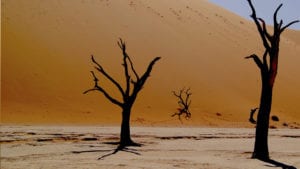
By contrast, the African who lives in utter poverty still sees the sky as God’s dwelling place and reveres it, while the earth remains a proper footstool—full of dust, fleeting, and fragile. African believers, in dust and poverty and much suffering, quickly appreciate that they are seated with Christ in the heavenly places, because that reassurance sustains them despite their suffering (Ephesians 2:6). On the other hand, an average man in Europe may think he is already seated in heavenly places. Why do I need Christ to relocate me?
The beauty of infrastructure, order and architecture easily becomes a new Tower of Babel, persuading people that they have already climbed into heaven itself (Genesis 11). The African feels very far from heaven and desires connection with God. The European, deluded by wealth and achievement, persuades himself there is no God at all, reasoning that with all our technological advancements we surely should have bumped into him by now.
The Parable of the Hornet
On my first night I prepared to take my first shower in Europe. But as I stepped in, I was stung by a hornet. Its sting was more bitter than that of the wasps we have back home. For me, the sting became a parable. It was a painful reminder that though I was surrounded by such stark beauty, I shouldn’t be deceived by the extravagance of wealth, the pomp on the streets, the impressive cars, the breathtaking houses, the spotless roads, and the impeccable order.
Sorrow remains. Europe is a place where people go to sleep and wake up in pain.
The illusion of safety and peace, which feels so heavenly, can actually be more poisonous and hellish than the sting of a hornet. The pain endured on my finger all night long reminded me that this is not yet home. We haven’t yet arrived. Not even in Europe. This world remains full of pain and sorrow. Europe is a place where people go to sleep in pain and wake up in pain. Many numb their inner wounds with strong drink or endless distraction, contrary to the wisdom once given to King Lemuel (Proverbs 31:4-5).
The Pierced Hand and the Pierced Saviour
If I’m still in pain, then in heaven I am not.
As I typed this reflection with a throbbing finger, the piercing pain reminded me of my salvation hidden in Christ. He was pierced for our transgressions, wounded so that we might be healed (Isaiah 53). The sting of my finger was like a sword in my heart, echoing Simeon’s enigmatic prophecy to Mary (Luke 2:35). I couldn’t ignore it. I didn’t know whether it meant I should be more watchful, less excited, more careful not to be seduced by Europe’s lavish lifestyle—but whatever it meant, I understood this much: if I am still in pain, then in heaven I am not.
The Long Sunset: God’s Patience in the Evening Sky
My first night in Belgium also taught me something else. I noticed that the sun set very late—around 10pm—whereas in Africa, the sun sets at around 6pm. What could this late sunset mean? This Babel-like empire, with its impressive structures, seems to compel God to come down and join people in their pride. People imagine they don’t need God. They have built prosperity, safety, and order here below. If God wants, he can join the party, but he is no longer necessary. Yet in his mercy, God prolongs the day. He extends the hours of light as a metaphor of his patience, his persistence in wooing Europe back to himself (2 Peter 3:9).
Europe, Europe, land of great thinkers and reformers—from Ambrose of Milan to Aquinas and Anselm, to Luther and Calvin, to Barth, to C. S. Lewis—how many times has God desired to gather you under his wings, like a hen gathers her chicks? But you were unwilling (Matthew 23:37). Still, God gives longer days. It’s as if he whispers: notice the light above before it is too late (Hebrews 3:15; Psalm 95). But just as the long days display God’s patience, so too the short days remind us of life’s brevity. When the sun sets early, let us know that the end can come suddenly and without delay.
One Lesson for Two Continents
Our God above gives meaning to all that is here.
Therefore, those of us in Africa must not look up cheaply, as if our poverty alone compels us to seek what is above. And those in Europe must not be content to look only around, satisfied with beauty and order. Both Africa and Europe must learn the same truth: he who is above sustains what is below. Our God above gives meaning to all that is here. For everything that exists has its being and moves in him (Acts 17:28).
DON’T HAVE PAYPAL TO SET UP A MONTHLY DONATION? If you would like to donate via Payfast – a secure payment gateway available to donors both inside and outside of Africa – please click here.